


Click here to read the full article.
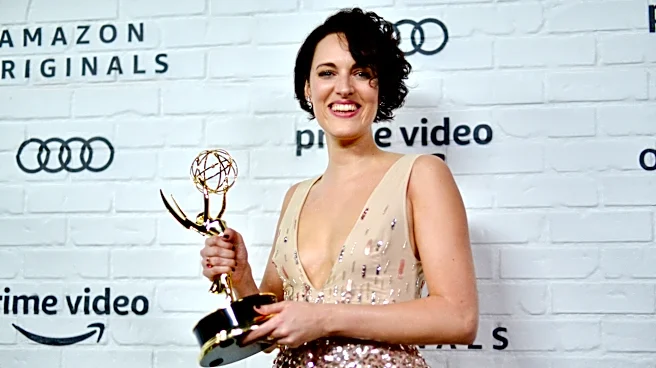
The Television Academy made it official on Tuesday morning: The Emmys are tossing the wheel and heading to the stream. Amazon’s Prime Video streamer has struck a six-year deal with the org to take over the Primetime
Emmys telecast effective next year.
Terms of the deal weren’t revealed, but Prime Video is believed to be paying a license fee of around $15 million for global rights to the Emmys beginning in September 2027, according to sources. Prior to that, the “wheel deal” mix of ABC, NBC, CBS and Fox paid around $8 million to $10 million annually — but that was only for domestic rights.
“It’s a meaningful investment,” said TV Academy chair Cris Abrego, who didn’t confirm a number but did say it was “definitely an increase” from the previous license fees.
Mike Hopkins, head of Prime Video and Amazon MGM Studios, also wouldn’t get into specifics on his investment but said he believed it was “a fair deal. We’re comfortable with it. We think it makes sense, particularly when you look at it over a long-term situation. We think we’re going to be ultimately very happy with it, as will, I think, the Academy.”
As for striking a six-year deal, Hopkins added, “It felt for them and us like the right number of years to see if we can together make a meaningful impact. We’re confident we will, and then my expectation is that this is a long-term partnership beyond six years. We’ll see what happens.”
The Prime Video deal not only signals the end of the “wheel deal” after 31 years, but it also moves the Emmys off broadcast TV for the first time since the ceremony began in 1949.
Under the new pact, the Emmys will be offered for free on Prime Video, as it will be placed in front of the paywall both here in the U.S. and in the streamer’s more than 240 countries and territories. The Primetime Emmys were previously syndicated internationally (except Canada and Australia) by U.K.-based distributor Rainmaker Content.
The deal also comes with the possibility of other Emmy programs also airing on Prime Video. That includes the artisans-focused Nights 1 and 2 (formerly known as the “Creative Arts Emmys”), which were previously edited into a condensed special a week after the ceremonies on FXX.
“We timed it perfectly so that all our deals came up collectively and it would be free and clear,” said TV Academy chairman Cris Abrego. “The wheel deal, the FXX deal and the international deals — all that has ended, and we put it all into one bundle, and it sits now within this deal at Prime.”
With that in mind, Abrego imagines partnering with Prime on creating a “road to the Emmys”: “We really talk a lot about just not making this a one-night event,” he said. “The Hall of Fame has really grown into something pretty incredible and special. That could be something. Our TV Academy Honors events. The interviews that we do. There’s a lot of opportunity to create content that builds to the Emmys.”
And then there’s the impending TV Academy merger with the National Academy of Television Arts and Sciences — which Abrego said is on track to happen as soon as mid-2027, prior to the next Emmys: “We’re moving along. It’s been a ton of work, and this has been a full year of us getting there. But I feel very positive on the timing of it for into the middle of next year.”
Once that’s done, NATAS’ awards shows (particularly the Daytime Emmys) could also be a part of the Prime Video mix — although that would require a separate license fee negotiation.
“Without getting ahead of things, that would be definitely explored, and I think it makes sense for us to do that,” Abrego said.
Hopkins agreed that the NATAS awards could “potentially” join this arrangement, but it’s still too early to discuss, as they’re just starting to get into details with the TV Academy on the Primetime Emmys now that this deal is done.
“We’d like to try to create an Emmys awards momentum that could increase the viewership and get people more excited about it,” he said.
As Variety exclusively reportedin September, Prime Video became the leading Emmys suitor after it appeared likely that the “wheel deal” wouldn’t continue, with at least one of the networks (believed to be Fox) dropping out. NBC aired the 78th Emmys last month, which was the final telecast under the most recent deal (struck for eight years in 2018).
Although the TV Academy looked into continuing the wheel, including adding some new partners to the mix, Abrego said the org was also eager to explore other options. (A multi-network and streamer simulcast/roadblock idea that had been championed by Variety was indeed considered, Abrego previously said, but logistical complexities ultimately doomed that scenario.)
“The wheel deal was incredibly successful for the Academy and the Emmys for a long time,” Abrego said. “But as we approached the end, I felt strongly that it shouldn’t just default to the way it always had been done.”
Although there was plenty of industry speculation that the TV Academy was having difficulty finding a new home as an alternative to the “wheel deal,” Abrego said the Academy had “a lot of choices” when it came to potential new homes, including some independent suitors that he declined to name.
But Prime Video became the front-runner option when they threw their hat in the ring. Hopkins said his team was keeping tabs on the Emmy renewal discussions, and started discussing whether they wanted to make a bid.
“What would we want to do differently and how would we approach it? What are the benefits of doing it on an annual basis, as opposed to every four years?” Hopkins said they discussed. “Once we got into it with Cris and his team, we realized that they too thought that it could be a good idea to make the Emmys a global event, on one service.”
Abrego said he saw an upside in sticking with one permanent telecast partner, rather than rotating between networks every year. The thought was that under the “wheel deal,” even if the Emmys did well, networks felt like they were just teeing it up for a competitor to take it over next year — limiting how much effort they’d want to put into the broadcast. At the same time, there’s the belief that an exclusive partner would likely be more motivated to expertly produce and heavily promote the Emmy telecast since they’d be airing it again the following year.
“The continuity is difficult when you’re starting new every year,” he said. “Where we are in this market and this climate, to start it fresh every year, to try to think of new creative, try to find new brand partners, and the next network might not be in the same position, that just made it very challenging to grow. We wanted a real kind of commitment and investment, to build and to evolve.”
Of course, the Academy has found it challenging in the past when it committed to just one exclusive telecast partner. The “wheel deal” originally existed from 1966 to 1986 between ABC, NBC and CBS — but then upstart network Fox grabbed exclusive rights in 1987 by dramatically outbidding the Big Three. Because Fox was still a fledgling network with less distribution and smaller audiences, the ratings plunged.
Then ABC took over exclusive rights — until competitors told the Academy they wouldn’t support the Emmys if it only aired on a rival. The ABC deal was scrapped and the “wheel deal” was born. The “wheel” was almost replaced once before, in 2002, when HBO shocked the networks by bidding $10 million annually for exclusive rights. But when the broadcasters threatened to boycott the show, the TV Academy stuck with the four-network status quo.
Now that the Emmys once again will be parked exclusively at one platform, will competitors balk? “I don’t think they will,” Abrego said. “All the industry are partners.”
Hopkins also wasn’t concerned that other streamers might resist a Prime Video Emmys — and noted that Amazon is already in business with many of them. “I think if we do this right, we want to celebrate the art of television, and we want to celebrate the best shows, the top talent that tells stories in that in that medium, because we love it,” he said. “We want to have Netflix’s biggest stars, and we want to have Disney’s, and we want to have everybody else’s as well. I think it’s a big opportunity, particularly if we can get on a nice growth trajectory globally and in the U.S.”
Hopkins pointed out that Prime Video Channels (formerly known as Amazon Channels) already sells subscriptions to a number of competitors, such as HBO Max, Apple TV, Paramount+ and Peacock. That could help fuel the Emmy telecast — what if you could subscribe a service as it won an award, to watch that show?
“A big part of what we offer our customers is our subscriptions business,” Hopkins said. “We have all of these large streaming services, a hundred of them that you can subscribe to and then integrate in into one seamless experience on Prime. Many of our partners win and are nominated for lots of Emmy awards. We’re at the Emmys, and we stand up and cheer when HBO Max wins and Apple TV wins because our customers have access to them, we’re partners. So we thought, we could probably do a great job with this. We’re really energized by the opportunity.”
The international component was also a draw to both the TV Academy and Amazon, Abrego and Hopkins said. Abrego said that more global series and stars have been Emmy contenders and winners in recent years (“Baby Reindeer,” “Squid Game”), while Hopkins noted that in the streaming age, there are fewer borders as some of TV’s most popular series and stars now air day-and-date all over the world.
“These are global stars, not just U.S. TV stars, and we think we can have a great impact on celebrating this medium and these storytellers globally around the world through the Emmys, in ways that it might be harder to do when you’re on a U.S. broadcaster,” Hopkins said. “We’ll make the Primetime Emmys available, front and center, on Prime Video. We’ll do what we can to celebrate it locally with local stars.”
Hopkins said Prime Video was eager to find ways to reinvent the Emmys as it moves to the streamer, but that doesn’t mean making it longer. When Fox surprised the industry and grabbed the Emmys in 1987, the network and producers tried to make a splash by letting acceptance speeches run as long as winners wanted. That year’s Emmys ran for four hours — still the longest in history. Although Prime Video doesn’t have a set schedule, which would allow for an Emmy telecast to run as long as needed, Hopkins dismissed the idea of making it longer to stuff in more entertainment.
“I think a three-hour award show is plenty,” he said. “I just think we want to take what we know works and enhance it in ways that can invigorate it for new audiences, similar to what we’ve done with Thursday Night Football.”
The biggest challenge will likely be educating viewers that the Emmys are no longer on broadcast, and migrating an audience to Prime Video. Abrego said that was the Academy’s biggest question in ditching broadcast for a streamer.
“It is and was one of our concerns, and it’s one of the things that Prime addressed immediately,” he said. “We had a big marketing meeting ahead of moving this forward to get an understanding of what this might look like, and it’s impressive.”
At the same time, he knows this landmark shift from broadcast to streaming has some parallels to when the TV Academy agreed to move the Emmys to Fox when that baby network was barely a year old. That year, the Emmys dropped to 14.4 million viewers — down from the previous year’s 35.8 million viewers on NBC.
“I have heard the idea of the comparison to the ’80s and Fox, and obviously it was a different time, and the landscape was so fundamentally different,” Abrego said.
Broadcast-to-streaming awards shows have a mixed record so far. Prime Video had previously acquired the Academy of Country Music (ACM) Awards after that kudocast left CBS in 2021; more recently, the SAG-AFTRA Actor Awards moved off linear (TNT/TBS) to Netflix. And coming in 2029, the Oscars will run on YouTube.
Hopkins touted Prime Video’s reach in utilizing promos on its own service (including during Thursday Night Football) to promote the Emmys, and he said they’ll probably also do some off-service marketing via social media and paid media spots. He also thinks having the Emmys consistently on Prime Video will eventually help with awareness.
“Every year it’ll be more of a consistent theme that will be a drumbeat to the Emmys,” he said. “I think will help us get there.”
As for the location, the Primetime Emmys has at least one more year left at the Peacock Theater at L.A. Live. Hopkins said he wasn’t fazed that the Emmys on Prime Video will be held at a venue that has naming rights with rival streamer Peacock.
“Peacock’s one of our subscription services that we offer to customers on Prime Video,” he said. “We haven’t really thought through the location … that’s not something that I’m too worried about.”