







Click here to read the full article.
Greece arrived at the Cannes Film Festival buoyed by a string of recent international shoots — like Christopher Nolan’s “The Odyssey” in the Peloponnese and “The Riders,” the Brad Pitt-led A24 title that filmed on the island of Hydra and across mainland Greece earlier this year –- as officials made the case that the country’s “Greece on Screen” audiovisual strategy is translating into sustained momentum.
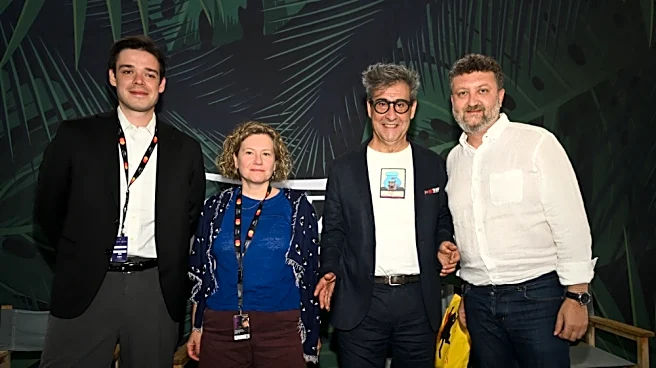
The Variety Global Conversations panel at Cannes brought together Leonidas Christopoulos, CEO of the Hellenic Film and Audiovisual Center (EKKOMED); Orestis Andreadakis, artistic director of the Thessaloniki International Film Festival and the Thessaloniki International Documentary Festival; film producer Konstantina
Stavrianou; and Edouardos Kalimeris, producer at Argonauts Productions.
“Greece on Screen” is the government-approved, five-year action plan running from 2026-2030 that’s backed by a baseline budget of €800 million ($927 million). Christopoulos said the number could rise to €1 billion ($1.15 billion) depending on how the program develops. More than €700 million ($811 million) is directed to its first pillar, which covers the existing 40% cash rebate for international productions, a new loan guarantee program for Greek producers and the simplification of funding procedures. Further pillars cover cultural diplomacy, festival support and investment in education, training, technology and innovation.
“There is currently an €8 million ($9.2 million) cap on the 40% incentive, but we are discussing increasing it in the next five years,” Christopoulos said.
Ecomed, which administers the plan, was formed by merging the former Greek Film Center and the National Audiovisual Center into a single body. A new technical school is being established in 2026 to expand the pool of qualified crew and post-production workers, alongside a center of excellence for video gaming.
The recent production roster extends well beyond Nolan and Pitt. Ruben Östlund shot “Triangle of Sadness” on the island of Evia, where Basque filmmaker Lara Izagirre is also preparing to shoot her adaptation of Federico García Lorca’s “Yerma” within weeks. Kalimeris cited Apple TV’s espionage thriller “Tehran” and the first two seasons of Prime Video’s “House of David” among numerous other international productions to have used Greece, with the latter filming across biblical and castle locations with local crews.
David Cronenberg shot “Crimes of the Future” in the country and, in an interview, said “the best technicians in the world are in Greece,” as recalled by Andreadakis at the panel. Greek crew are also building careers internationally. Kalimeris cited a focus puller he worked with who went on to crew “Indiana Jones” in Italy.
The Thessaloniki International Film Festival’s industry segment, the Agora, is the primary platform for connecting Greek and international professionals, with a focus on Southeastern Europe and the Mediterranean that extends at times to Scandinavia and the Baltics.
“To film in Greece is a unique opportunity to film under the gaze of gods and on the coastline under the Olympus Mountain,” Andreadakis said.
Athens-based producer Stavrianou, who co-founded her company 25 years ago, said flexibility is the country’s key differentiator beyond locations and crews. Christopoulos described Greek crews as problem-solvers who resolve difficulties on set rather than letting them compound.
Greece’s local filmmaking is visible at this year’s Cannes through Konstantina Kotzamani’s Un Certain Regard entry “Titanic Ocean,” a Japanese-language debut feature set inside a boarding school where teenage girls train to become professional mermaids, co-produced across Greece, Germany, Romania, France, Spain and Japan.