




Click here to read the full article.
In some ways, an adaptation of the Bret Easton Ellis novel “The Shards” has had some of the heavy lifting done for it. Ellis’ cooly detached prose style embodies the shameless materialism of its Reagan era setting with
an obsessive catalog of proper nouns: what kind of cars its characters drive; the brand of clothes they wear; the songs they listen to on repeat; the specific routes they take through the wealthy precincts of Los Angeles.
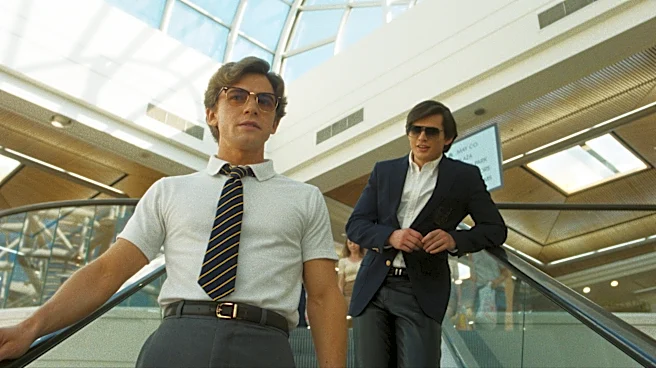
Such details act as ready-made stage directions for the FX series of the same name, co-created by Ellis and prolific producer Ryan Murphy. The first two episodes of “The Shards” closely track the opening chapters of the source material. This literal approach works to conjure the atmosphere of the book, a kind of autofiction that blends Ellis’ actual experience attending prep school while writing his breakout debut “Less Than Zero” with an increasingly lurid plot about a serial killer stalking his classmates. Ultravox’s “Vienna” and countless other contemporary hits conjure the time; shots of Mulholland Drive and a recreation of the Sherman Oaks Galleria in its heyday evoke the place. A foundation is laid for the reality of our unreliable narrator, played here by Igby Rigney, before it starts to fracture into the series’ titular pieces.
But then “The Shards” starts making big, bold choices to stake its claim on the story. And that’s when things start to go off the rails.
At least “The Shards” gets one crucial, and quite difficult, thing right: Rigney is terrific as the young Ellis, making the part’s many contradictions and internal struggles perfectly legible to the outside observer. Bret is, as one character observes, “aloof,” a combination of writerly remove and his closeted homosexuality. Yet Rigney excels at playing both sides of Bret’s double life: not just the illicit hookups with school stoner Matt (Owen Painter) squeezed between dates with his rich, beautiful and popular girlfriend Debbie (Hayes Warner), but the sophistication he so avidly cultivates that can’t fully cover up the naïveté of youth. Bret does drugs like a pro and lives on his own while his parents swan off to Europe. He still can’t hide — or rather, Rigney shows — his discomfort and confusion when thrust into nuanced, grown-up situations, like the way Debbie’s father Terry (Wes Bentley) looks him up and down while promising to read over his screenplay. Terry, a Hollywood power player, tells Bret that every story is about loss, be it love, life or innocence. There’s no confusion over which kind of loss most interests “The Shards.”
The arrival of the killer known as the Trawler, who mutilates his victim’s corpses into morbid tableaux using animal parts, corresponds with the wool falling from Bret’s eyes. (The feeling of being constantly surveilled by some unknown entity is also that of a young gay man who’s terrified of being found out.) “I’ve crossed over into this other world of death and adults,” says Rigney’s voiceover, much of it lifted wholesale from Ellis’ prose. “One day, I’m gonna feel like a kid for the last time.” Rigney is so strong that his performance helps justify the otherwise odd choice to make him the narrator, who’s meant to be older and refracting the series’ events through decades’ worth of hindsight. A well-known, middle-aged actor might make more thematic sense — or even Ellis himself, who first originated what would become “The Shards” on his podcast.
Sadly, Rigney’s talent also has the unfortunate side effect of highlighting how much the other two load-bearing roles in “The Shards” are lacking in execution. The first is model and actor Kaia Gerber as Bret’s best friend Susan Reynolds, the goody two-shoes class president and straight-A student to Debbie’s unrepentant wild child. Yet Gerber, who’s shown a skill for deadpan comedy in other acting parts like “Bottoms,” comes off as exactly what she is: a Glamazon in her mid-twenties who shows absolutely none of a sheltered high schooler’s inner conflict when weighing whether to flirt with her own dark side. The casting is so misguided, and in line with Murphy’s proclivity for flashy celebrities, that it’s hard to fault Gerber herself.
The other critical flaw in “The Shards” cast is the part of Susan’s temptor: Robert Mallory (Homer Gere), a new student at the Buckley School (Ellis’ actual alma mater) who instantly attracts Bret’s coupled lust and suspicion. In fairness to Gere, an entertaining if small presence on Season 3 of “Euphoria,” Robert is a jumble of traits it’s hard to package into one person. He’s a potentially violent psychopath who gets in a car chase with Bret before rattling him with lewd descriptions of what he’d like to do to Susan. He’s also meant to be plausible as a lonely teen struggling with mental illness; that’s how Susan reads his prior stint in an institution, leading her to ignore multiple warnings from both Bret and her insecure boyfriend Thom (Graham Campbell). Bret naturally interprets this data point much less charitably.
This is the challenge, of course, in translating “The Shards” from Ellis’ claustrophobic and paranoid point of view for the camera’s all-seeing eye. (Often, Robert is supposed to come off multiple ways to multiple people in the very same scene.) But where it feels additive to see how Bret’s friends react when he starts spouting conspiracy theories and indulging his obsession with the Trawler, Robert comes off more wooden than menacing, more handsome than seductive. He works better as an object of Bret’s fantasies, or maybe delusions, on the page than as a flesh-and-blood human being.
With these handicaps in place, it’s unlikely “The Shards” would ever rise to the level of “American Psycho,” an Ellis work whose film version starring Christian Bale helped cement the story even further into the zeitgeist. But how the full season unfolds virtually guarantees it.
To pad out the plot, Murphy and his collaborators insert dated and stereotypical teen tropes: an episode set at a public access dance show, á la “Hairspray” (which took place 20 years earlier); an attempt to cultivate suspense around the race for homecoming queen. Each of these additions runs directly counter to the jaded sophisticates the protagonists of “The Shards” are supposed to be, muddling the mood Ellis once curated so carefully.
That mood includes the sense of dread induced by the Trawler, another delicate balance “The Shards” utterly botches. “Kids these days have it fucking easy,” Bret scoffs. Gen Z may have smartphones, he explains, but “we had to deal with serial killers.” Alongside the Night Stalker and Manson-esque cults, the Trawler is introduced as a kind of tone-setter, establishing grisly murders as a fact of life to be greeted with blasé, semi-comic indifference. But the masked figure becomes less effective the more active a role he plays in the proceedings. “The Shards” is simply unable to cultivate and sustain the needed ambiguity about whether Robert could really be the Trawler or how much Bret is imagining things. Showing the Trawler at work through the eyes of Rhonda (played by internet provocateur Ivy Wolk), a kidnapped classmate of Bret’s and a new addition to the show, dispels much of the mystery and menace. Intended reversals around red herrings and likely suspects instead land with a thud.
Much of this off-kilter feeling stems from the terribly misguided decision to trade Ellis’ macabre crescendo for a planned multi-season run. This expansion is why “The Shards” amps up supporting characters like Debbie’s miserable mother Liz (a be-banged Evan Rachel Wood), who gets a ludicrous arc straight out of “Boogie Nights” that feels wildly out of place. And it’s why the show transforms at the last minute into a whodunit that turns the Trawler from an ethereal boogeyman into a Scooby-Doo villain waiting to be unmasked. Ironically, the more the Trawler comes into focus, the less interested I became in his identity. “The Shards” is a feeling, and the Murphy version can’t capture it.
The first two episodes of “The Shards” will premiere on FX and Hulu on Aug. 5 at 9pm ET, with remaining episodes airing weekly on Wednesdays.