


Click here to read the full article.
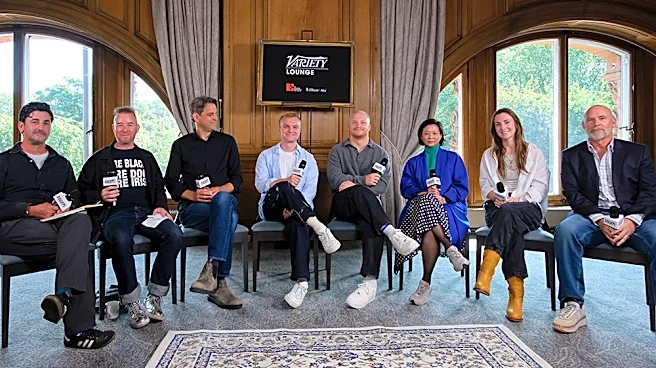
The chaos, hard graft and — ultimately — privileged thrill of feature filmmaking were the central themes of conversation at the Variety Lounge at Edinburgh International Film Festival as the rising directors in official
competition sat down to discuss their craft.
Supported by VisitScotland and held in Edinburgh’s historic Caledonian Hotel, the Variety Lounge welcomed the 11 directors behind the 10 films competing for the Sean Connery Prize for Feature Filmmaking Excellence. For all but three, the film was their feature debut, although that didn’t stop them from immediately breaking the unwritten rules of directing.
“My film was shot entirely on water, and if you learn one thing — and I went to film academy — it’s that if you don’t have a big budget or masses of experience, don’t shoot on water,” admitted Dutch director Thom Lunshof, behind the post-apocalyptic sci-fi “First Zone,” adding that he found himself on day two of the shoot with “drowning actors, cameras falling into the sea and boats that sailed off into the horizon with my main actress on it.”
But despite the chaos unfolding in front of him, Lunshof said it made him realize “how special it was to do something like this for a first film. And we’re still alive! We didn’t drown!”
U.S. filmmaker Tyler-Marie Evans, whose debut “Pretty Babies” tells the story of two aspiring Hollywood stars who get sucked into the adult industry, recalled “one of the craziest shoot days” where it dawned on her that she was, now, a feature film director.
“We had an insane amount of pages — all these different motels in one day. And one of our actresses, Sadie Stanley, had a very intense scene. After she shot that she just collapsed in my arms, crying, like ‘I gave you everything!’” she said. “And I thought that was such a transcendental moment. It really reminds me why we do this and the stories that we create in that process of production, and what a privilege it is working as a director and connecting with your actors and hopefully audiences.”
For Ollie Gardner and Jake Harvey, feature debut directors behind riotous tearjerker “The State of Us” — about two old friends on a final night out — they were able to share the burden and excitement of making their first feature with each other.
“We’re blessed that we got to do it together. We’re best friends making a film about two best friends, so it kind of felt right to do it,” said Harvey. “It’s a hard thing to make independent film and your debut film. And there’s a lot of battles that need to be fought and won, and you have to stay true to your vision and also compromise in every area that you need to. But when there’s two of you that get to fight each other’s battles and soundboard off constantly — it meant everything became a creative challenge rather than like a logistical challenge. But it was a lot of phone calls.”
As Gardner noted: “I think our girlfriends are probably questioning our relationship!”
While she didn’t have a co-director to lean on, Canadian director Frieda Luk said she had the wise words of a friend in her mind while in production on “Sacred Creatures,” a slice of magical realism set amid a family reunion in Italy. “She was like, ‘Remember you are making a feature… be thankful for every shot you have’,” she said. “And so after that, before I said ‘action,’ I would just look around the room and look at all the crew and all the cast and just say thank you to myself and the crew. And that really made me feel like, ‘This is happening, I’m supposed to be here and we’re gonna get this done.'”
Simon Ryninks, behind sci-fi comedy-drama “Out There,” managed to land Welsh acting legend Michael Sheen for his debut feature, something that made him realize he was “really having to step up,” but was also an incredible honor.
“[He’s] someone who I wrote a part for and we somehow miraculously got him in this film. And I think working with someone like that is such a privilege,” he said. “It was a kind of masterclass in watching him work and seeing a performer embody a role like that.”
U.S. filmmaker Lindsey Ryan noted that there was something particularly special in being in Edinburgh to showcase her feature debut “Capsized,” following a dysfunctional family on boating holiday, as it was here where she got the call that her pitch was getting the green light. “This is one of my favorite cities. And we just happened to be here on vacation,” she said. “So it feels very surreal and sort of serendipitous that this is where we’re going to premiere the film.”
In making “Snapshot,” a found-footage horror sent in Jack the Ripper era London, Brit Joseph Archer found himself in the unusual situation for debut director of having to negotiate filming locations with Netflix.
“We’re this really small team — and I was the cinematographer as well as the director — and we’d start shooting for about 30 minutes and then this whole circus of Netflix would turn up,” he said. “They’d be like, ‘We’ve got permission to be here.’ And I’d be like ‘Well, we’ve also got permission to be here.’ So we’d then be negotiating with Netflix to be like, ‘OK, you shoot on that side of the graveyard and we’ll shoot on this side.’ So that was a very different experience.”
One of the few filmmakers in the lineup with a couple of director credits already to his name, Kieran J. Walsh — behind the drug-fueled and music-soaked Northern Irish drama “Skintown” — reflected on making the seismic leap from shorts to features, something all the directors had experienced.
“A feature film is like ‘Fitzcarraldo,’ I felt like I was dragging a boat up a hill,” he said. “But everybody else was dragging it with me — and some people were pushing from the back, and we were going to get that boat right up on top of that hill, and hopefully you don’t slide down the other side. But there was an energy between everybody coming together, and particularly on this film.”
For all the Werner Herzog references, Walsh noted that while feature filmmaking may be “tough,” he “just couldn’t do anything else at this stage.”
It was a sentiment echoed across the lineup of Edinburgh competition directors, who, whatever struggles they may have faced in making their films, were all keen to get straight back behind the camera on their next feature (Evans noted that she’d “just wrapped her second feature last week.”)
“It’s an addiction,” said Paul Wright, director of “Mission,” an intense study of isolation and mental illness led by George Mackay (and his second feature with the actor, who appeared in his 2013 debut “For Those in Peril” and won a BAFTA Scotland award in the process). “It’s about that idea that keeps you awake at night and keeps you writing on notebooks. So I’ve got two or three different new ones bubbling away.”
The only documentarian in competition, Canadian filmmaker Bart Simpson — behind the film “The Mad World of Harvey Kurtzman,” about the founder of Mad Magazine — said that the trials and tribulations of putting together an unscripted feature were just as tough as making a narrative film.
“I know people who’ve been working on a film for 12 years. Luckily this took maybe eight, but it’s still in the same realm,” he said. “So I think the ‘what’s the next film?’ is always the question that we love to hear and also kind of dread to answer right now, because we’re just happy that this one is out. I look forward to hearing what everybody’s going to be making after this. But I also look forward to seeing what you’ve gotten in the can.”