




Click here to read the full article.
John King was phoning from Maine, but his most important calls won’t take place until Tuesday night. When King takes uphis regular position at CNN’s “Magic Wall” during Election Night coverage, he will do so with a new
layer of digital bell s and whistles at his command. He has a floating “Key Race Leaderboard” that shows how the closest races are tracking in real time. And he will be able to show viewers whether costs of gas, rent and groceries have gone up or down in every county and precinct, so viewers can see whether rising costs appear to play a role in how voters from each party cast ballots.
“It’s a powerful visual,” says King, who has manned CNN’s signature voting-data board since 2008, when a former CNN Washingotn bureau chief, David Bohrman,discovered the technology on display at a military-intelligence trade show. The system was originally designed to help Pentagon analysts utilize a touch-sensitive screen to map out their work in real time.
Such technology isn’t just there to dazzle the eye. For the nation’s big TV-news networks, the feature has become increasingly critical to business as well.
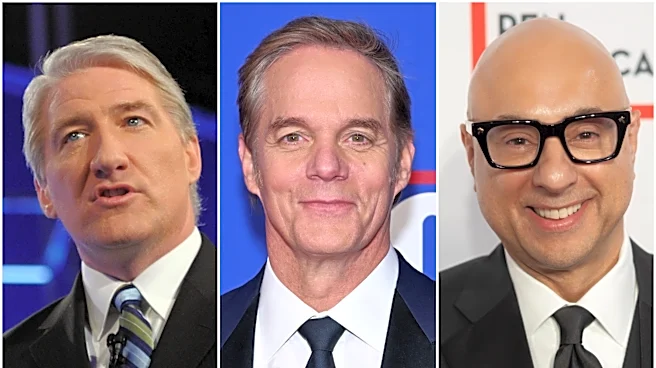
Viewers have long been accustomed to seeing King and others such as Fox News’ Bill Hemmer and NBC News’ Steve Kornacki manipulate colorful screens on set and rattle off stats and data. Indeed, the element has become so de rigueur that none of the networks can envision an Election Night telecast without it. The anchors might spotlight a specific viewer’s home county or state, and the visuals make the process of distilling numbers, percentages and exit polls much easier. At MS NOW, Ali Velshi works the board. Ed O’Keefe keeps up on stats for CBS News and Rachel Scott and Rick Klein oversee the task for ABC News. CNN also has Harry Enten and Phill Mattingly on tap.
Now, these correspondents stand increasingly at the center of new products and content presentations the networks hope keep viewers focused on their screens, and not someone else’s. NBC News is counting on Kornacki not only to charm TV viewers with his data insights, but to entice digital followers with a stand-alone “Kornacki-cam.” So important is Kornacki’s presence to both program, that NBC is tapping new technology that will let the correspondent stay in the NBC News TV studio even as he talks directly to the digital crowd by blocking his voice from the linear audio feed.
“We never want Steve to have to stop talking, and we prefer not to put Steve in a different space,” says Marc Greenstein, an NBC News executive vice president who oversees many aspects of Election Night coverage . It’s crucial, he says for NBC News anchors like Savannah Guthrie and Tom Llamas “to instantly interact” with Kornacki during the night.
Meanwhile, MS NOW will stream a YouTube feed giving its viewers a look at Velshi, and is running a contest to win one of his signature vests. “You won’t hear the audio, but you will get the point,” says Velshi, who notes that followers will gain an understanding “of what the team determined what is going to be important to cover and why.”
Fox News Channel’s Bill Hemmer and his “Bill-board” have been a years-long mainstay of Election Night coverage. This year, says the anchor, his data will be used to create a “brilliant graphic we can cast out on to the studio floor” that lets viewers “watch the vote count come in to the counties that matter. Our audience will be able to see where the votes are coming from and why or why not we have called a particular state.”
ABC News will introduce a new feature called “Vote Shift” that examines how voters in each country may have changed their attitudes since 2024. “When President Trump won, we saw a really dramatic shift across all states toward the Republicans, even in the states that voted for Kamala Harris,” says Jenn Metz, executive producer, special events and news specials planning at ABC News. “This time, we are able to visualize how voters are shifting in real time.”
In an era when the networks are competing more directly with independent journalists and so-called “creators” who lead newsletters, YouTube streams or video podcasts, the data boards, walls and screens given them a gee-whiz edge over their indie rivals. The information is seen as “reliable. It’s accurate. You can trust it,” says King. And only a news organization with money and resources can put such a system in place. All that can reassure viewers who wonder where the nation is headed. “Elections make people tense. You’re on a side. You want to see if your party, your team wins. Our elections of late are so close,” King notes, and displaying the underpinnings of how people vote and why may offer some reassurance.
Critics worry that the digital screens create a sense of “gamification” around one of the country’s most serious nights, particularly at a time when more viewers have grown interested in online wagering and prediction markets. Combined with orchestral theme music and other flourishes, the boards may add to a sense of drama rather than toning it down.
Hemmer believes the influx of local data can be reassuring, with even people in the studio “drawn to the locations they are more familiar with.” He may be directed to focus on certain areas of the country where a tight race is unfurling, but he will also look for interesting local stories. If he thinks there’s something of significance in a certain area, “I will find a way to get there as well.”
Still, there is something to be said for not deluging the viewer in on-screen gimmicks and graphic flashes. The technology, after all, was initially created to offer viewers a simple distillation of voting trends. “You don’t’ want to overdo it,” warns King., “There are people out there who question election integrity, who say people are trying to rig the elections, who say you can’t trust the media,” he says. “We want to make it better when we can. We also want to be careful not to complicate it so people say ‘What did they do?’”
Mastering the screens and the data behind them takes weeks of study as well as work with hand motion. “It is brute force learning, on a daily basis,” says MS NOW’s Velshi. Hemmer is known to study at the New York Public Library to ensure he has a quiet space for learning the granular details of voting patterns and political conditions around the country. King practices on a “miniature version” of the Magic Wall on an iPad. “If I have free time can move around and make suggestions about how to make it more user friendly, he says.
An update to the software or the features creates a situation not unlike an upgrade to an iPhone, says Hemmer. “You have to learn a new trick, and that’s exciting every couple of years.”
Another important skill? Knowing how to get out of a glitch on live TV.
Elections tend to bring a wider swath of viewers than typically watch the news networks. And while digital boards are fun to look at and can hook new audiences, an unexpected pause for buffering displays can be agonizing as the counts keep coming in. “How do you get out of a situation where you don’t want to be, and how do you do it clean and quick, so the audience doesn’t get confused with what they are watching?” asks Hemmer. “That takes practice.”
Drilling down into very granular areas poses another kind of test. Local color can be great, says King, unless the details are wrong. If you travel “to somebody’s home and talk about the politics there and the texture of the community, you’ve got to get it right.”
Chances are the news outlets will continue to find more uses for the boards, not fewer. It’s easy to envision future election and primary “multi-casts” in which different people examine the boards for different kinds of data, with each getting their own live stream. The screens transform reams of data into easy-to-understand images, illustrations and diagrams, and when it comes to TV, says Velshi, “the visual sense is stronger than the auditory sense.”