




Click here to read the full article.
On the final day of the 10th annual SCAD AnimationFest in Atlanta, 10 animators and an Oscar-nominated director took the stage to talk about the future of their craft and why the human hand still matters.
The 2026 class
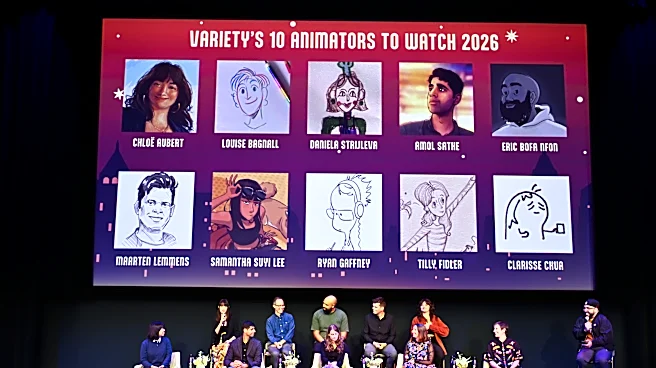
of 10 Animators to Watch, profiled in Variety’s New York issue, represents a broad cross-section of the medium. The group includes artists from Ireland, France, Belgium, Bulgaria, Singapore, Hong Kong, Canada and the U.S., working across hand-drawn, stop-motion and CG animation at studios ranging from Hollywood’s biggest houses to independent productions. Each honoree also created a self-portrait for the issue. Variety moderated this conversation in partnership with SCAD Film Festival.
This year’s talented up-and-comers included Louise Bagnall, director of Cartoon Saloon’s “Julián”; Daniela Strijleva, production designer of Pixar’s “Gatto”; Tilly Fiddler, a stop-motion animator on Laika’s “Wildwood”; Amol Sathe, director of cinematography and lighting on Walt Disney Animation Studios’ “Hexed”; Clarisse Chua, storyboard artist on Brad Bird’s “Ray Gunn” and Nathan Greno’s “Swapped”; Chloë Aubert, animation director of “Iron Boy”; Maarten Lemmens, lead animator on DreamWorks Animation’s “Forgotten Island”; Eric Bofa Nfon, animation director of the hand-drawn feature “Tangles”; Ryan Gaffney, head of story on Warner Bros. Pictures Animation’s “The Cat in the Hat”; and Samm Lee, storyboard artist and animation director on Sony Pictures Animation’s “Spider-Man: Beyond the Spider-Verse.”
“Earlier this year, ‘KPop Demon Hunters’ won the Oscar for best animated feature, and behind every one of those wins is a small army of artists whose names often get overlooked,” Variety chief awards editor Clayton Davis told the SCAD audience. “Animation is film, and we must treat it that way.”
Several members of the class had good reason to be somewhere else. Lemmens’ “Forgotten Island” was the closing-night film of this year’s SCAD Animation Fest, the same day the movie opened in theaters across the country. Sathe, Strijleva and Lee are still working on and finishing their films.
Nonetheless, the conversation quickly became a reminder of just how much work goes into an animated film — and how many of those decisions never make it into the public conversation.
Bofa Nfon discussed the decision to move his “Tangles” animators away from the industry-standard twos and onto threes and fours, with one sequence even animated on eights. The choice wasn’t merely a budgetary calculation, though working at a slower frame rate meant fewer drawings for the independent production and created a different texture. “You don’t just take twos and push them into threes or fours,” Bofa Nfon said. “You have to think about the motion and where to select your drawings.”
For Lemmens, the challenge on “Forgotten Island” was learning an entirely different visual language. When the directors began sending anime films to the crew, Lemmens realized he had some catching up to do. “I haven’t really watched anime,” he recalled thinking. He spent his Christmas break doing his homework and eventually became one of the film’s anime specialists because he was “one of the few people that actually did that homework.”
On the upcoming “The Cat in the Hat,” Gaffney helped crack the notoriously difficult and iconic characters Thing One and Thing Two by taking inspiration from the Baby Herman cookie sequence in “Who Framed Roger Rabbit,” the blockbuster 1988 live-action and animation hybrid. “The Things want to eat Waffles,” Gaffney told the crowd, about the character who is voiced by actor Matt Berry. “And I thought, ‘OK, I can take that somewhere.’”
For Chua, working with Bird on “Ray Gunn” meant learning how to interpret a director whose vision had been developing for decades. Bird sent the story team to study films including Roman Polanski’s “Chinatown” and Curtis Hanson’s “L.A. Confidential.” In contrast, Chua studied choreographer Busby Berkeley for a particular sequence. “It taught me how important it is to watch a lot of movies and understand your director,” Chua explained.
Bird’s process was also highly physical. When Chua pitched something that wasn’t working, Bird would sometimes acknowledge that his original instructions weren’t working either. “He would bring out his camera hands and start running around the meeting room, which was awesome,” she said.
Eventually, the conversation turned to the subject hanging over virtually every creative discussion in Hollywood: artificial intelligence. Each of the panelists does not treat AI as a single problem with one answer. Instead, they returned to the craft, specificity, collaboration and the value of work that bears the fingerprints of each of its creators.
Bagnall argued that the greatest defense against generic AI-generated imagery is to become more specific, not less. “AI tends toward homogeneity,” she said. “It tends toward the middle ground, the generic kind of solution to a problem. With that in mind, you can lean into specificity. You can lean into your own point of view. Nobody else has your point of view on the world.”
Aubert, whose “Iron Boy” premiered at Cannes, has heard variations of the same technological death sentence before. Fifteen years ago, she was told that 2D animation was disappearing in favor of 3D.
“I’ve never done 3D animation in my life,” she admits. “I secretly know how to do it, but don’t tell anybody.”
Her answer to technological change has been straightforward: keep making the work she wants to make. Aubert further explains: “I always laughed about it, because all I wanted was to draw, to animate, to share feelings with people. I just did what I wanted and showed what I wanted to do, and the more I showed that, the more people gave me work for it.”
Fiddler, a SCAD graduate in 2022 who went from an intern to a team member on the upcoming “Wildwood,” had a more personal reaction. “Before I was super aware of AI, I would see something that was AI and not clock it and then someone would tell me and I was immediately not interested in it anymore,” she said. “I watched behind-the-scenes footage of people making it, and it’s passed down through generations. I find that really emotional and exciting, and it’s what makes me want to keep making art.”
Lee, who’s working on the top-secret and highly anticipated “Spider-Man: Beyond the Spider-Verse,” acknowledged that the uncertainty is real but argued that fear should not obscure the medium’s history of adaptation. “It’s a little scary, but I believe in us,” Lee asserts. “I don’t think we have to be afraid.”
Sathe agreed that technology should not obscure the industry’s most important asset, and that is its people. “A lot of the buzz nowadays is around technology, but at the end of the day, the best projects come from people collaborating, bouncing ideas off each other and relying on their teams, both emotionally and creatively,” he shared.
The panel also gave shout outs to the jobs on an animated project that deserve more credit. Those included production teams, technical directors, editors, IT workers, riggers and stop-motion’s so-called “puppet hospital.” Aubert had a particularly strong case for cleanup artists. “There’s a lot of ego in this industry, because animators can be stars and it gets to your head,” she shared. “So please don’t.”
Production teams received similarly strong praise. Gaffney, who began his career as a production assistant, said those teams are essential to keeping productions moving. Lee compared production workers to the “blood vessels” of a film.
Panelists like Lemmens warned students against viewing their classmates as competitors.
“Don’t treat your relationships with the people around you as competition,” he said. “What I’ve found is that being collaborative and being friends with the people around you, asking for feedback, ‘What do you think of this?’, encouraging each other to show stuff, actually gets you way further.”
Bofa Nfon offered a simpler lesson for those entering their first jobs. “At your first job, there’s a tendency to want to impress people and figure things out on your own,” he shared. “But don’t suffer in silence.”
The conversation ultimately returned to a question Variety posed on the first-ever “Pixels and Pencils” panel at SCAD in 2021, and has carried through every year since: Who will be a part of the first animated feature that will win the Oscar for best picture?
One student, Lily, a senior 3D animation major from Milledgeville, Ga., raised her hand and was brought onstage and dubbed her the group’s “11th animator to watch.”
The panel then offered Lily a collective crash course in surviving the animation business, unexpected opportunities and, as Lee put it, remaining curious about people outside the animation world. “Love everything you can love,” she shared. “Love other people, not just artists and people in the industry you want to go into, but people who aren’t in that industry.”
And then finally, Joel Crawford, the director of DreamWorks Animation’s “Forgotten Island” and the recipient of the Variety Creative Impact Award, screened his new movie as the closing night film of the fest and sat down for an intimate discussion and signed posters and books for each of the over 400 attendees of the screening.
He co-wrote and co-directed the movie with his best friend, Filipino filmmaker Januel Mercado, and saw this as a love letter to a culture he loves so much. “With Januel being Filipino American and my wife being Filipino, and growing up in the Philippines, she would share stories that she was told and that kind of stuck with me and it felt like it’s time to celebrate the Philippines.”
Crawford, who received his first Oscar nomination for “Puss in Boots: The Last Wish and will be returning to the fifth edition of Variety’s “Pixels and Pencils,” spotlighting the directors behind the year’s standout animated features, at SCAD Savannah Film Festival on Oct. 26, had helpful advice to a room of aspiring artists. “[Do] not let other people’s success be failure because it’s so hard to not compare and it’s so hard to embrace the unknown. I think that’s the one that sticks with you of try and do your best to celebrate all the people around you and their successes. And don’t worry, it will come to you.”