







Click here to read the full article.
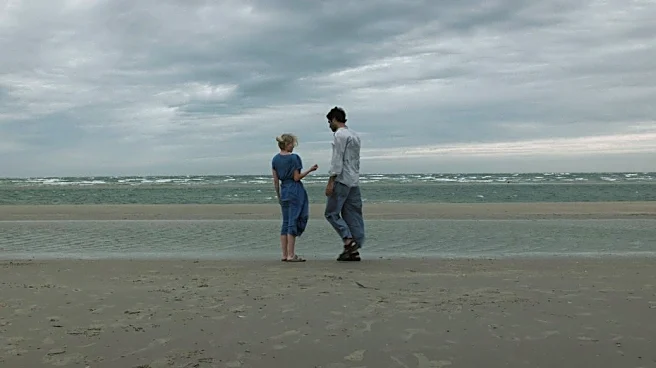
On a windy afternoon, a family packs a beach bag, perhaps for the last time, and languidly walks towards the coast. A sense of gloom hangs in the air. While the child and her mother play in the sand, the father tackles
the seemingly impossible task of setting up a tent to provide shelter. As he begins to fill the bags with sand to weigh down the tent, the wind keeps trumping his efforts, shoveling more sand inside the tent. There’s a sisyphean sensation, emphasized by the instrumental version of a song looped in the background for most of the film.
Following his previous Special Mention for the 2021 title “First Time” at Locarno, Nicolaas Schmidt’s debut feature film “September Afternoon” premiered last week in the Cineasti del Presente section.
“September Afternoon,” which begins with footage from a ’90s ice cream commercial and the words “a post-postmodern persistence parable,” adopts the clichéd advertising aesthetic — frontal shots overlaid with music, extreme close-ups set against glistening waves — only to turn it on its head, gradually deforming it into something monumentally strange and unrecognizable. While the film lacks dialogue altogether, elemental gestures are often exaggerated, especially when caused by the wind: At times, the sand lifts in waves, covering the frame in a grainy hue; at others, we hear the sound boom shifting with a thud.
The film was shot over just a few days and, although the production had planned for a sunny, nearly windless beach, preparing to generate wind artificially, the weather had other plans. The strong winds not only carry the sensation of discomfort, but also serendipitously become an integral character of the film.
Schmidt alludes to the impossibility and unreliability of language, preferring color and soundtrack to dialogue as a means of conveying various moods. Later in the film, after the separation of the father from the rest of the family, the color red comes to signify a sense of desperation. “I’m not afraid of using clichés.”
Perhaps what is most compelling about “September Afternoon” is its resistance to narrative time. As in his previous works “Final Stage” (2017) and “First Time” (2021), the accretion of dead time (temps morts) here becomes a guiding principle: What initially appears familiar — the seductive, polished language of the commercial image — begins to resist its own legibility, opening instead onto texture, duration, and sensation.
This tension is sustained by the film’s movement between the conventions of narrative cinema and the durational logic of video art. Midway through the film, an idyllic walk by the sea, captured in extreme close up, gradually zooms out into a medium shot and finally into a wide shot. Lasting more than 10 minutes, the image begins eviscerated of scale and depth before slowly recovering a figure-ground relationship — from a smudgy surface to be contemplated to an image of a body moving through a landscape. Later, a woman protractedly licks blue ice cream from a cone, her attempts thwarted by ferocious gusts of wind and sand.
Strewn across the film, such sequences suspend narrative development, allowing images to linger beyond their immediate function. As Schmidt remarks, “I am more interested in experimenting, in getting surprised by an idea … the artistic starting point of a work.”
Notwithstanding its pop-inspired aesthetic, there is something almost elemental in Schmidt’s blocks of image and sound, evocative of the earliest days of cinema. It is perhaps fitting, then, that “September Afternoon” includes a clip from Philippe Garrel’s silent and dreamlike avant-garde classic “Le Révélateur,” also centered around a nuclear family. Garrel’s film, a major influence on Schmidt, offers a way to encounter cinema beyond its linear framework: “an in-between state of sleeping and being aware, a fascinating place for cinema to be in.” If “Le Révélateur” revels in highly contrasted blacks and whites, “September Afternoon” finds solace in subtle modulations of grey, of colors either highly saturated or bleached to the point of indiscernibility.
The film’s critique of the commercial image also acquires a distinctly contemporary resonance. Schmidt himself is conscious of how the visual grammar of advertising has migrated into the endlessly curated feeds of social media.
“Today, it’s less commercials and more social media, stuff like Instagram … problems about fakeness and over-idealization. We all can see it around us. It’s a bit concerning how the world will be, and how the current generation will turn out.”
In a world saturated with information, where every image is already endlessly recycled and re-appropriated, attention itself becomes a political act.