







Click here to read the full article.
Like countless others, director Graham Parkes has spent the past week immersed in “Grand Theft Auto.”
He knows the landscape better than most. A narrative designer, filmmaker and co-founder of video game development
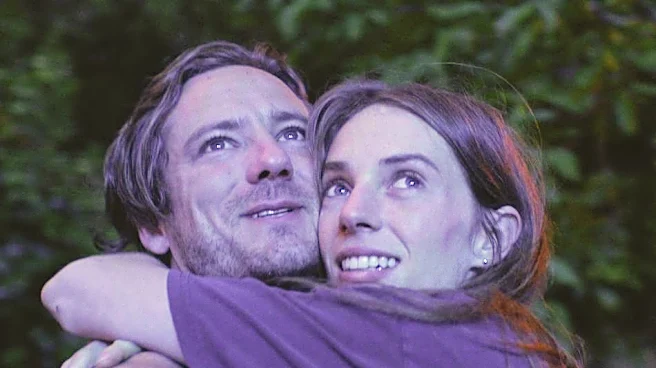
studio GoodbyeWorld Games, Parkes brings both careers together in his award-winning feature debut, “Wishful Thinking,” now playing at the Torino Film Festival. Led by Maya Hawke and Lewis Pullman, the off-kilter rom-com follows a couple whose domestic moods wreak havoc or work wonders on the world around them. That a dynamic not unlike theirs should underpin the mechanics of “GTA 6” isn’t lost on Parkes.
“We’re in conversation with ‘GTA,'” he laughs. “I love that!”
The overlap is no accident. Parkes set out to bridge his two creative worlds, enlisting familiar collaborators such as GoodbyeWorld co-head Oliver Lewin as composer and peppering the film with Easter eggs from games he has long admired. Gaming also figures directly in the story, with Hawke playing a game designer whose work feeds into the larger narrative.
“It’s ‘write what you know,’ but I also wanted a subplot that treats games like any other art form,” he says. “They’re in the midst of a renaissance, particularly in the indie space. It’s a small part of the film, but I wanted to celebrate a medium I love.”
Gaming also provided a blueprint for the production itself. Parkes found that the resourcefulness of indie development translated neatly to low-budget filmmaking.
“Early on, we talked about how to make a scrappier production work for us,” he says. “To use gaming lingo, how could we turn a bug into a feature by leaning into our limitations?”
One answer was the film’s playful use of split-screen. Parkes wanted a more fluid visual language than what a rushed indie shoot typically allows for.
“In a lot of indie films, and I understand why, because you have so little time, you can really feel the coverage. The characters sit across from each other, and it’s shot, reverse, wide, because you’re moving so fast. We wanted to glide through time and be with them in natural environments, because if you live with a partner, you’re rarely sitting across from them talking.”
“Split screen made movie [more interactive], because the audience has to choose which frame to follow. I don’t think we’ve even scratched the surface of what you could do.”
Parkes also borrowed a game-development technique to get ahead of practical challenges.
“In game production you create something called a ‘vertical slice,’ a five-to-10-minute chunk that you take to full polish,” he says. “It becomes the yardstick for everything else, both in how it works and feels and in what it will take to build. Only then can you fully budget and schedule. That kind of iterative process sometimes feels missing in film.”
For “Wishful Thinking,” Parkes applied the same principle, shooting seven pages at his cinematographer’s house before editing, scoring and color-grading the footage to establish the film’s look and feel ahead of principal photography.
“When we went into full production, we had a real sense of what worked and what didn’t, and a clear yardstick to keep referring back to, which became invaluable, especially when we were under the gun,” he says. “Fully mounting a small chunk of your movie before you create the whole thing is something filmmakers could consider more often.”
The strategy paid off. “Wishful Thinking” won the top dramatic prize at SXSW before selling to Sony Pictures Classics, which plans to release it in February 2027, just in time for Valentine’s Day. Until then, Parkes is enjoying watching his latest obsession become a cultural phenomenon on an almost unprecedented scale, though he’s wary about any wider lessons.
“It feels like every couple of years society decides games are art,” he laughs. “As someone who works in the field, it almost feels embarrassing that people need to announce that. Games have thoroughly proven themselves. ‘GTA’ is amazing, and, given the specifics of that game, I don’t know that a monoculture moment like this will ever happen again. But as a gamer, it’s been amazing to see the medium shed some of its negative associations.”
“I’ve existed in the indie space, making games that aren’t violent,” he continues. “We always talked about making games that could pass the ‘mom test,’ meaning anyone could play them without prior experience. Over that time I’ve seen the medium lose its association with a certain kind of toxic male identity. For millennials and Gen Z especially, it has become maybe the most defining monoculture medium, for both genders, and that’s been really exciting.”