




Click here to read the full article.
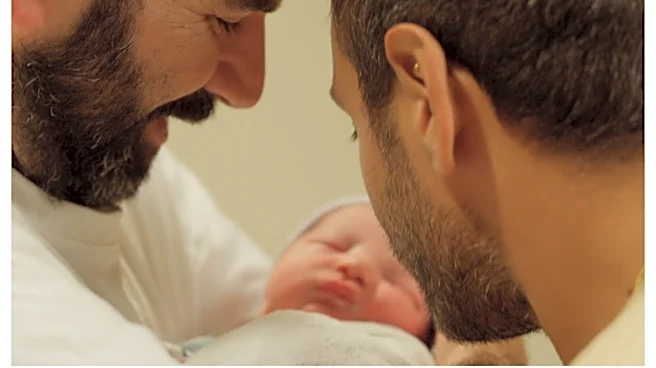
Timely documentary “Father Father” — premiering at Festival do Rio — follows a Jewish Israeli named Aviv and Khader, his Palestinian-Israeli husband, as they travel to Texas where a surrogate delivers their baby, Albi,
on the eve of Hamas’ Oct. 7 attack.
Directed by British documentarian Jake Witzenfeld — who in 2015 made a splash with “Oriented,” following three Palestinian gay men in Tel Aviv during the lead-up to the 2014 Israel-Gaza conflict — “Father Father” is an intensely personal love story that clashes with the horrors caused by politics and war. Inevitably, this puts a strain on Aviv and Khader’s relationship, but ultimately doesn’t break their dream of forming a family.
“This film definitely wants to keep alive the dream of a possibility of love across difference, and the hope that it can exist even in this very dark moment,” Witzenfeld tells Variety in his first interview for “Father Father.”
“There’s no question that we are in a challenging cultural moment for films that want to try to say that there can be an opening [between Israelis and Palestinians],” he adds. “But I hope that Khader, Aviv and Albi’s story can do just that.”
How did “Father Father” originate?
Well, in spring of 2021, Khader — whom I have known since I made “Oriented” more than 10 years ago — called me and said that he and his partner Aviv, whom I also knew, were thinking about starting a family. There was obviously the seed of something from a storytelling perspective. At the time, I was living in London and was working on a range of different projects. But I was able to kind of cobble together enough development money to start following the process, without committing to any outcome of where it was going. My instinct was that it felt like an interesting time to start looking at the future of a Muslim and a Jewish mixed gay couple in Tel Aviv.
Why at this particular time?
Bibi [Benjamin Netanyahu] was soon to be voted out. He was kind of hanging on in 2021. There was a period where he was out of power for about nine months. Then he came back in, and we started making the film in that context. That’s really the origin of it. Initially, it didn’t have a clear direction. It was an exploratory piece about about their ability to do this inside the country. Then, once Bibi came back — and the government skewed extremely to the right — the film took on this kind of macro context of whether they could hang in there and fight.
There is this key moment at the surrogacy agency when they are told that the two parents have to be of the same religion. Does that reflect changing policies in Israel?
To me, it’s one of the most fascinating moments in the film. It shows the complexity of the state of Israel — a country that undeniably has a broad range of liberal freedoms that are in negotiation with the nature of the state as Jewish — and I think that moment is kind of absurd. That a gay mixed [Israeli/Palestinian] couple can go sit there, be offered coffee, shake hands, no one feels threatened, everything’s cool. And yet there’s this piece in the policy which pokes its head [and forces them to find a surrogate in Texas]. From my perspective, I would like there to be total freedom.
Tell me more about the symbolic significance of this film for you, even before Oct. 7.
The protests that we see in the film, that Khader and Aviv attend, are in response to the judicial reform of the country that threatens to upend their safety as a gay couple in the country. I think as a British Jew, and as someone that has spent a lot of time in Israel, I was drawn to that. I was drawn by the fact that stories like Khader’s and Aviv’s need amplifying to make sure that aspects of Israel that make, or made, the country very, very special were not being lost. And I could see them becoming lost. I think that’s still in contention, right? How this film plays inside inside Israel right now will be very interesting. Obviously, there’s an election coming up in a few weeks, which will be very deterministic. But before the start of the war, that was the driver.
And then Oct. 7 came crashing in. That changed lots of things, right?
We had wrapped the Texas shoot around the birth of Albi on Oct. 6, and we were planning to fly back to Tel Aviv with them around the 10th and continue shooting there. And then obviously everyone woke up on the 7th, and plans changed. They decided to wait in Texas for, I think it was a month, and I extended as well. We continued filming there, and then we intermittently filmed over the course of the following year up to Albi’s first birthday, which obviously coincides basically give or take a week with the first year of the war.
Oct. 7 also puts a strain on Khader and Aviv’s relationship. What are your thoughts on that?
I think they’re incredible as a couple. They came out of COVID into a multi-year, mega-expensive process with complex medical procedures involving birth and then a war that hit them a week later. It’s kind of insane. I don’t know if I’d have the emotional intelligence to survive a relationship in those contexts. So first and foremost, I just admire their love and its stamina and its resilience. But it [the war] absolutely takes a toll. And we captured a moment where that comes to the fore, and in which their differences and contradictions couldn’t really be any louder. And the film makes room for those, without needing to resolve them. Which is what Khader and Aviv do. They make room for those differences without needing to resolve them. I think that’s a beautiful lesson right now. At a time when we can barely sit next to somebody on a bus who has contradictions with us, I think there’s something incredibly powerful about that.
Did the emotional impact of the war affect the filmmaking process?
From a filmmaking perspective, the access diminished because they became protective. They had a newborn in a country that was at war, with relatives who were in the [Israeli Defense Forces] reserves, with relatives who were suffering fatal consequences, at times. We acknowledged that. Khader speaks to that in a very raw way. And the end of the film was really a chance for him to to say what he wanted to say to Albi.
Towards the end, the film goes also goes into the dynamics of the relationship between Khader and Aviv’s families. How would you describe them?
Before we started shooting in 2021, Khader and Aviv had worked through a lot of acceptance with their respective families. Even before they knew each other, they worked through a lot of acceptance with their families as individuals. But I think the final scene kind of speaks for itself. You have Khader’s mother in a hijab, sitting there talking to Aviv’s brother with an AK-47 on his lap, because he’s in reserves, and they are talking about, like, cooking. To me, the fact that that can happen is incredible. As you know, they obviously have very different opinions, and come from very different worlds. They go home and watch very different news. But there’s something about that, that, in a small way, this film chooses to celebrate.
This interview has been edited and condensed for clarity.