




Click here to read the full article.
Antonin Baudry’s two-part World War II epic about Charles de Gaulle made its U.S. premiere Saturday at the American French Film Festival in Los Angeles, drawing a seven-minute standing ovation after both installments,
each running more than two and a half hours, played back-to-back to packed audiences at the DGA Theater.
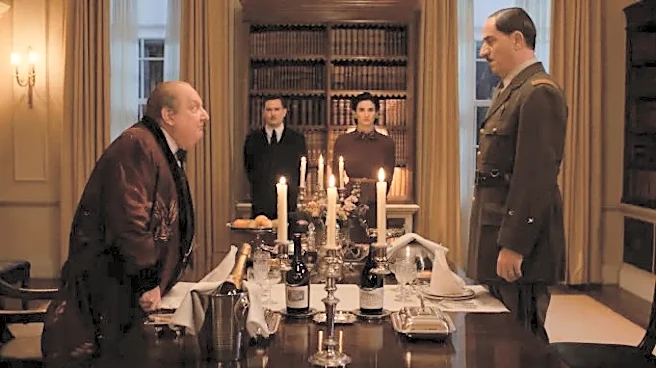
The €74 million production, starring Simon Abkarian as the French general and Simon Russell Beale as Winston Churchill, marks one of Pathé’s boldest gambles following “The Count of Monte Cristo” and the two-part “The Three Musketeers,” which were also distributed in the U.S. by Samuel Goldwyn Films.
After a slow start in France, the films quietly gained momentum through word of mouth, becoming a domestic box office success and selling over six million tickets, and are now gaining traction internationally. In the U.K., the first installment, “De Gaulle: Resistance,” which charts De Gaulle’s heroic battle to build a Resistance movement after France surrendered to Nazi Germany in 1940, currently ranks as the highest-grossing French-language film of the year. “De Gaulle” has also just been acquired in China – a rare feat — where Light Films will release it in late November.
In the U.S., Goldwyn is rolling out the epic theatrically across major U.S. markets, including New York, Los Angeles, Chicago, San Francisco, Washington, D.C., Seattle, Austin, Minneapolis, Houston and Atlanta, while making it available nationwide on transactional VOD. The second film, “De Gaulle: Liberty” will be released in early December.
Speaking to Variety during the American French Film Festival, Peter Goldwyn said he’s betting that the sprawling saga can appeal to U.S. audiences even if it revolves around a French historical figure that many aren’t familiar with.
“The films have proven themselves, and audiences are audiences, whether they’re American or French,” Goldwyn said. “It’s an amazing feat of filmmaking that you don’t quite see anymore and ultimately, World War II is an easy entry point for U.S. audiences.”
“U.S. audiences have been very much enthusiastic consistently about stories about Roosevelt, about Churchill, and I think that the story of De Gaulle is relatively untold in America,” he continued, adding that the “staggering scope and scale of what (De Gaulle) accomplished as one man is pretty amazing.”
Goldwyn argued that the films’ cinematic ambition places them closer to Hollywood blockbusters than conventional European arthouse fare.
“As a film itself, you’re looking at something on the scale of ‘The Odyssey.’ It’s just really broad and massive, and yet instead of getting lost in the effects and the war itself, it really does come down to a character study which drives the story along. So you’re not just sitting there watching World War II play out,” he said.
“The only thing that makes it an arthouse movie is because it’s in a foreign language,” he added, pointing out that the French language “makes it hard for theaters to commit on that wide of a screen count.”
As such, Goldwyn opted to pair the theatrical run with a nationwide transactional VOD release, giving the films the best chance of finding their audience.
“In France it had this sort of slow start and was really discovered, but theaters in the U.S. don’t have the patience or time to let things be discovered. It’s sort of you’re in and you’re out,” he said. “So it’s a combination method.”
The distributor is mounting a single campaign for both installments, targeting not only arthouse moviegoers but also history buffs, schools, cultural institutions and younger audiences through social media. “I think it’s enhancement, especially when you have two movies of this length, you need word of mouth and if you can only have a couple showtimes a day, you can only get so many people into the theaters,” Goldwyn said.
The appeal of the films also lies in the fact that they challenge the familiar American and British narratives of World War II, exposing the tensions between De Gaulle, Churchill and Franklin D. Roosevelt, played by Campbell Scott.
Baudry and his co-screenwriter, Bérénice Vila, read more than 150 books and dug into historical archives to reconstruct the general’s extraordinary journey from an isolated, virtually unknown military officer in 1940 to the leader of the French Resistance, as well as his relationship with Churchill and Roosevelt.
“They had different conceptions of war. Roosevelt, for his part, thought Churchill was being completely absurd with his romantic ideas about supporting this admirable little leader called De Gaulle. To Roosevelt, the idea of Free France was a little fantasy of Churchill’s,” said Baudry.
The director said the complicated relationship among the three leaders remains largely unknown outside academic circles.
“All of this history has never really been told. Historians, real historians who research this period and have access to the sources, know all of this, but the general public doesn’t. And the version of history taught in schools is not very complete,” he said.
Despite the historical complexity, Baudry wanted the films to be accessible to viewers with no knowledge of De Gaulle, so he organized early screenings for young students outside academic circles.
“My goal was that you could watch the film without any outside references, without ever having heard of that period or of De Gaulle,” he said.
One of Baudry’s boldest choices was casting Abkarian, a renowned actor with a career in film and theater who isn’t a bankable star, to embody the towering historical figure.
Abkarian spent roughly six months preparing for the role of De Gaulle, whose rigid posture, distinctive voice and almost eccentric behavior have long made him difficult to portray.
“I read the screenplay more than ten times. I read it and reread it and annotated things,” Abkarian told Variety. “There was nothing to change in the writing, not even a comma. The dialogue was really well written.”
The iconic monologues came more naturally. “There were the great speeches, and that’s where I feel at home because I come from the theater and I know how to approach them.”
Abkarian also transcribed every line of his dialogue into a small notebook that he carried throughout the 150-day shoot and eventually gave to Baudry.
“All the dialogue went right up to the very last page. I hadn’t planned it that way, but every page was filled. I didn’t have to use another notebook,” he said.
But the actor eventually abandoned the idea of simply reproducing De Gaulle’s mannerisms. “You can’t represent a character like this in a strictly anthropological way. You can invoke him, evoke him, but you can’t actually become him. And it wouldn’t make sense to try,” he said.
One breakthrough came when Abkarian and Baudry spent an evening recording De Gaulle’s speeches together.
“We explored how far I could go in approaching his voice, its frequency, its musicality and the way he emphasized certain words that wouldn’t naturally occur to you. I had to understand his logic, the way he articulated his thoughts through language,” Abkarian said. “I couldn’t make him speak in the ordinary, conversational way I’m speaking to you now. Between doing nothing and caricature, I had to find the right balance.”
The screenplay portrays Churchill and De Gaulle as unlikely allies bound by mutual admiration despite their frequent clashes, and Abkarian found an easy partner in Russell Beale.
“Simon is an incredible actor who has a profound understanding of great texts, and we have the same approach to the craft,” Abkarian said. “The writing provides such rich material for the actors, particularly for De Gaulle and Churchill.”
For Abkarian, Churchill and De Gaulle were united by an idealism that set them apart from Roosevelt’s political pragmatism.
“Churchill and De Gaulle were romantics. They recognized that quality in each other. That’s why they developed that friendship,” he said. “And that’s what makes their relationship beautiful, as well as mad and contradictory.”
Abkarian is less certain than Goldwyn about how Americans will respond to the films’ portrayal of their wartime leadership, but he believes De Gaulle’s defiance could strike a chord, particularly in today’s political climate.
“There may be something in De Gaulle’s struggle that speaks to Americans’ own battles, to their sense of nobility and their democratic convictions,” he said. “I think that, from that point of view, Americans could recognize themselves in the Gaullist struggle.”
Goldwyn, for his part, sees a hero Americans will recognize. “It’s a story of an ally,” Goldwyn said. “This man was very patriotic, which I think is very American. He didn’t go along with what his government dictated and said, ‘I don’t believe this, I need to fight for my country.’”