




Click here to read the full article.
Willem Dafoe is in the midst of a massive year — and he’s playing a character whose life is small by design.
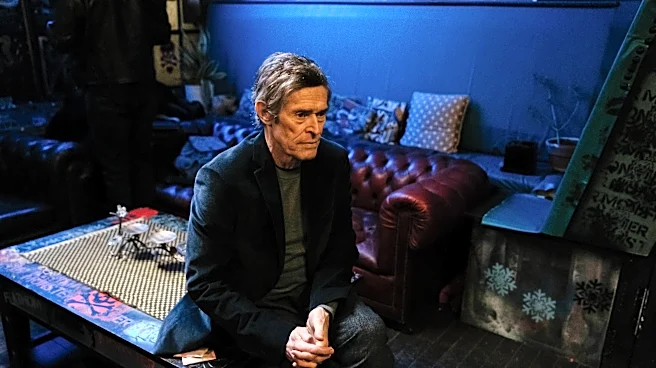
In director Kent Jones’ “Late Fame” (out Aug. 7 in New York and Aug. 19 in Los Angeles and other cities), Dafoe
plays Ed Saxberger, a postal employee who, in his youth, had been a published poet and edged up to real success. Whether by choice or circumstance, Ed has faded into utter obscurity, and seems to like it that way — until Meyers (Edmund Donovan), the leader of a group of self-styled intellectuals that also includes a glamorous but fading actress (Greta Lee), introduces himself to the man he calls an artistic forebear. Suddenly, Ed is at the center of a social whirl that destabilizes him, and makes him wonder if fame isn’t actually so bad.
Dafoe is hardly chasing notoriety, but Saxberger’s impulse to put down his pen and walk away from work is very unlike him. His five other 2026 projects include “Tenzing,” in which Dafoe plays the commander who led the first successful attempt to surmount Everest, and “Werwulf,” the latest Robert Eggers gothic-horror freakout, this time set in the 13th century.
Since beginning his career in New York’s experimental theater scene in the 1970s, Dafoe has ranged from indie cinema — with his two most recent Oscar nominations coming from Sean Baker’s “The Florida Project” and Julian Schnabel’s “At Eternity’s Gate” — to major productions. Of late, his collaborations with Eggers (“Nosferatu,” “The Lighthouse,” “The Northman”) and with Yorgos Lanthimos (“Poor Things,” “Kinds of Kindness”) have been particularly fruitful. But those performances tend toward the grander-scale; in “Late Fame,” Dafoe is muted and interior, conjuring both the cerebral quality of a poet and the stoicism of someone who had believed he had made the choice to live a quiet life.
Variety spoke with Dafoe about the film, and about lessons he’s learned over a long career.
Your character has left his art behind and seems not to reflect upon it much — it’s a chapter of his life that is now over. For you, the act of making art seems so fundamental. Did you find it challenging to relate to his decision to walk away?
No, only because there were so many models for me. When I went to New York City, there was a scene there. At least it felt that way as a young man. I wasn’t part of it — I was basically locked in a theater, trying to make theater pieces. But I was aware of a scene, and, as part of that scene, there were poetry readings and loft performances. A lot of those people that I knew, they burned hot, they were making interesting things, they did what they did with passion, and they weren’t thinking of career. They were in freefall.
The scene went away. Things changed, and they didn’t have the community to sustain them. And then people get practical. So I had lots of models of people who did beautiful work as young people and weren’t thinking of career, and then one day they came to peace with another way of living. I don’t have judgment — when we first see Saxberger, he’s not a sadsack.
You may have been on the outskirts of a scene, but I know how involved you were with experimental theater, as a founder of the Wooster Group in the 1970s. “Late Fame” is all about the interplay between youthful passion and the wisdom of experience; looking back at that time in your life, do you recognize the spark you brought to your work?
Sure! Because I’m self-deluded enough to think I’m still a young man. I seek out people that are turned on like that. It becomes infectious. Because of the eclectic choices I’ve made sometimes, I like going back and tapping into that younger energy, which you can find from younger people.
You’re on a career run that has included multiple films with both Yorgos Lanthimos and Wes Anderson. What qualities do you seek out in a director?
Passion, I need. When they’re turned on. If I give myself to a director, I don’t want them to be doing the job. I want it to burn hot. I want it to be a life experience — and maybe that’s too much to ask. But in the best situations, you’re changed. It wakes you up out of habit, and that’s important.
You’ve been a fixture both of indie cinema and of the “Spider-Man” and “Finding Nemo” films. Are you as able to find the excitement you describe in a big-budget studio project as you are in a small story?
I have been. It is possible. With smaller films, they have challenges, but they do have a certain kind of flexibility, too. The challenges are different. But on a big movie, things have to be a little more planned, a little more sure, a little more measured, and there’s more cooks in the kitchen. On smaller movies, sometimes there are more opportunities — sometimes out of poverty, sometimes out of inexperience. But having to find solutions, it always turns me on. The bigger movies have to be charted out clearly, because there’s such a financial stake. That’s not totally bad, because, with that kind of clarity, you can put your efforts to the very clear tasks you have to do. In [smaller movies], they may lean on you more to collaborate.
One of the tricks of being an actor is, when you enter a movie, you’ve got to identify what we’re trying to do. You don’t have to have an absolute answer, but you’ve got to say, What is the world? How can I contribute something? What room is it? What is my function? What needs to be done? Where can I push? Where can I hold back?
A collaborator of yours who splits the difference for me — where he makes grand-scale entertainments that have a scrappiness to them — is Robert Eggers. There’s a real sense of play to his work. You’re in his next film, “Werwulf”: What has the experience of working with him over time been like?
Oh, I adore working with him, because everything’s clear. He gives me fun things to do. It’s like Lanthimos, and other directors I work with: They make the world, and they don’t defer. It’s his world. He has collaborators that help him a great deal, but they’re so in sync that it’s so specific, it’s so strong.
He puts you in a world that’s very challenging. So you’ve got to step up, and that’s your contribution. He gives you not only fun things but very difficult things; he designs shots very specifically, and you have to bend yourself to the shot, serve the shot, but also play the scene. That is a kind of combination, because you have a clear plan that you have to submit to. But inside of that, there’s lots of space to kick it up.
I want to close by talking about the scene in which your character stands onstage and reads a poem he’d written decades before. The poem seems to chart the character’s emotional journey, but does so in a very enigmatic, elliptical way — kind of like how poetry works. As a non-poet, how did you prepare to play that scene?
We struggled a lot to find the right tone for that poem. Kent has some poet friends. I have some poet friends. Ultimately, Kent wrote it, and then I had some details that I really required to personalize it. He came up with a poem that was, in the end, a combination of me and Saxberger. I was quite happy reading that poem. It meant something to me.