

Click here to read the full article.
Paolo Strippoli, who is Italy’s hottest young helmer of genre movies, is back at Venice Film Festival with “The Spiral.” The high-concept thriller stars Valeria Bruni Tedeschi as a demonic character called The Stranger,
who entices a young mother played by Jasmine Trinca into forging a Faustian pact.
“The Spiral” centers on a mother-daughter relationship that spirals out of control following a shocking revelation. At the film’s start, a woman named Anna suddenly shows up at her daughter’s Alice’s house during a thunderstorm saying she wants to tell her a dark truth about their family. She claims to have made a pact with The Stranger to save Alice’s leg after an accident 20 years earlier. That pact “has triggered a domino effect causing terrible events over the years. Only Alice can help to put everything right. But at what price?” the synopsis says.
Besides Tedeschi and Trinca, “The Spiral” cast also comprises Romana Maggiora Vergano (“There’s Still Tomorrow”) and Adriano Giannini (“Supersex”). The film was lead produced by Rome-based Propaganda in tandem with France’s Kazak Productions.
Strippoli made his directorial debut in 2021 with “A Classic Horror Story,” a hit Netflix Original film he co-directed with Roberto De Feo. In 2022, he helmed his second feature, the psychological horror “Piove.” And in 2025, Strippoli’s third movie, “The Holy Boy” launched from Venice.
Below, Strippoli speaks to Variety about working with his top-notch cast on “The Spiral” and reveals an exclusive clip from the film.
How did this story originate?
“The Spiral” was born as a novel that I wanted to write. Then, when I told this story to my co-screenwriter, Salvatore De Chirico, he said, “Let’s make it into a film.” It was born from my fear of not having control over things in life. It’s a film about control, about how it’s impossible to determine our destiny. We live in a society, in a world that teaches us and pushes us to self-determination. But the truth is that self-determination is not always possible.
Would you say this is a film about motherhood or, more broadly, parenthood?
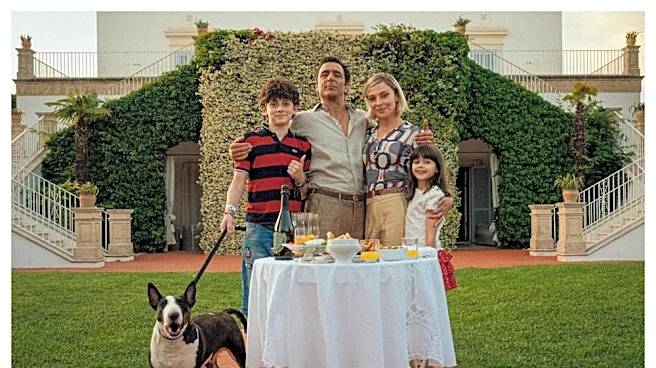
One of the themes is parenthood and a way of conceiving motherhood and parental love as control and ambition that is projected onto one’s children. Not that Anna Colonna or Walter Colonna, the parents in this family, are evil, They are certainly overbearing personalities, but they are not bad people. I have never seen them as people who don’t truly love their children. Simply, they are a product of the society in which they live, the city of Bari at the end of the last century, a time of great industrial and economic growth. What we see are these rich people who are social climbers with new money after having achieved a certain social status. But they were not born into that social class.
Talk to me about working with Valeria Bruni Tedeschi, who plays the role of The Stranger?
She’s an amazing actress and also very generous on set. First of all, I want to say that it was very easy to convince Valeria to do this film, maybe also because the role was written for her. I couldn’t imagine anyone other than Valeria Bruni Tedeschi in the role of The Stranger. Because in this film, Valeria does truly horrible things, but she does it with a lightness that is also very funny. Sometimes she makes you laugh, but it never takes away from the cruelty of what she is saying. I think Valeria is one of the few Italian actresses — even though she’s an international actress, she lives in France and works in France —who has this quality of never judging the things she says. They are always suspended in time and tone.
Talk to me about casting Jasmine Trinca as Anna Colonna, in what is an unusual role for her.
We wrote the script with Jasmine in mind, but she was harder to convince than Valeria. It took us years, and now she laughs about this. I didn’t want any other actress, even though everyone who read the script was like, “I love Jasmine Trinca to bits, but it’s not a role I expect from her.”
Why was Jasmine Trinca perfect to play Anna Colonna and what indications did you give her?
Because Jasmine is deeply empathetic, almost sweet, even when she does and says mean things in movies. She has an empathetic quality that always makes you feel for her, that makes you always love her. It’s because she’s an actress and a person of great emotional intelligence. As for my indications, even though she always keeps her acting naturalistic, we worked on making it clear what type of mother Anna is: her rigidity, her control. We worked on achieving this. Anna is a character who could easily be labeled unpleasant, mean and evil. But the way she is played by Jasmine, she is a mother who — in her own twisted, sick and sometimes perverse way — wants the best for her children and the best for her family.
Do you consider this a horror film?
No. I never conceived of this as a horror film. For me, it’s always been a psychological thriller; a puzzle that comes together as the film progresses. Obviously, it plays with the tropes of horror films, a genre that I love deeply and am very familiar with. But over time, I think I’ve figured this out: definitions of the category or the genres of a film should be given by the people who see it: by the [industry] professionals, by critics and journalists and by the audience. My job was to tell this story in an honest and entertaining way. So, I never thought about the specific genre of this film. I just thought it should be an exciting journey for the viewer, obviously. Then, when I saw the film for myself, this confirmed to me that it’s not a horror film. Once I assembled it and I started editing it, and got the complete, overall vision of what I’d done, I saw that it definitely went in the direction of a psychological thriller. Because it’s a film that works on twists and turns, on revelations. It’s a puzzle, where the last little piece arrives in the final shot of the film.
This interview has been edited and condensed for clarity.