






Click here to read the full article.
As cumbersome and overlong as the 28-year wait between the 1998 original film and its sequel, “Practical Magic 2” serves as a next-generation reminder that sometimes the best way to let a beloved experience live on is
by leaving it behind in one’s memory.
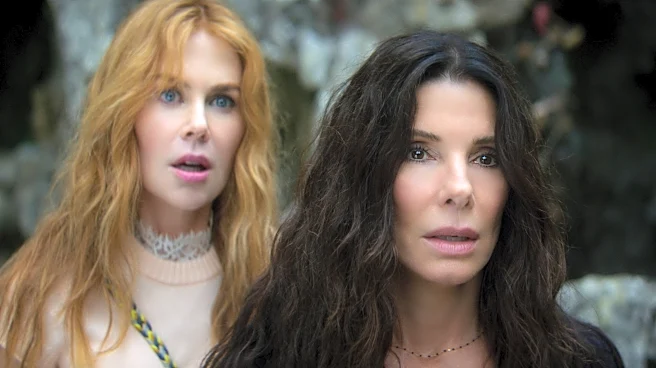
Led by Sandra Bullock and Nicole Kidman, director Griffin Dunne’s adaptation of Alice Hoffman’s 1995 novel “Practical Magic” gained a cult following over the years for its unwieldy combination of romantic comedy, domestic abuse and, yes, magic by using female friendship as the glue holding it together. Returning as producers, reuniting them with costars Dianne Wiest and Stockard Channing and replacing Dunne with Susanne Bier (who directed Bullock in “Bird Box,” and Kidman in TV’s “The Undoing” and “The Perfect Couple”), the two leads play the hits, repeating many of the elements that made the first film beloved — and, in the process, inadvertently exposing why not everyone thought the original was that great in the first place.
Bullock reprises her role as Sally, the older and ever more cautious of the Owens sisters. After two marriages that ended with her husband’s death because of a generations-old curse, Sally not only swears off romance but casts a spell that makes her twentysomething daughters Kylie (Joey King) and Antonia (Maisie Williams) forget they they’re in a family of witches. When Kylie’s boyfriend Gideon (Xolo Maridueña) gets critically injured shortly after she confesses her love for him, Gillian (Kidman) forces her sister to reveal the truth about the Owens women, causing a rift between a lovestruck daughter and a mother who wants only to protect her from heartbreak.
Rifling through the belongings of her great-aunt Jet (Wiest) for a spell to save Gideon, Kylie finds the Book of Ravens, which cryptically hints at an incantation that might break the Owens’ love curse. She follows its clues to England, where she meets Thomas Lockland (Solly McLeod), a young farmhand whose family’s history intersects with hers. In the meantime, Sally receives a tip from her aunt Franny (Stockard Channing) to speak with Ian Wright (Lee Pace), a British academic who’s well-versed in the dark arts. Enlisting Ian’s help, Sally and Gillian drag their oversized luggage across the United Kingdom to track down Kylie, hoping to prevent her from using newly-rediscovered magic powers that risk causing more problems than they solve.
Though the first “Practical Magic” was only a modest hit upon its release, the thing that resonated most strongly with fans was its emphasis on sisterhood — not simply the blood oath between sibling opposites Sally and Gillian, but generations of margarita-drinking, Harry Nilsson-listening Owens women, and eventually, the estranged neighbors who come together at its climax to save Gillian from her (literally) demonic ex-boyfriend. But the film was also a byproduct of an era when a female character’s success was measured by her romantic relationships with men. At the end, boy-crazy Gillian was free once again to love like there was no tomorrow — imagine Samantha from “Sex and the City,” with potions instead of cosmopolitans — and Sally married Gary (Aidan Quinn), literally the man of her dreams, who it turns out died not long after the events of the first film.
Sally’s widowhood and Gideon’s coma are necessary both for the plot of “Practical Magic 2,” but also to ensure that the focus remains on the Owens women. In the time between the two films, Sally and Gillian have gone from finishing each other’s thoughts to constantly interrupting each other’s sentences, an evolution in their sibling dynamic that’s true to life, but considerably less charming than the script (by Akiva Goldsman, Georgia Pritchett and Kelly Marcel) presumes. Yet while the film features one scene after another of its female characters unblinkingly supporting one another, it oddly sidelines Jet, Franny and Antonia in favor of Ian, a hunky intellectual ripped straight from the cover of a romance novel.
It’s not Pace’s fault that Ian is distractingly appealing, fully dedicated as he is to admiring the love-resistant Sally. But the film dilly-dallies so long before its characters unravel the central (and pretty obvious) mystery, that finding a way to exclude Ian at the climax of the action feels like a dereliction of duty to the audience. At 130 minutes, the sequel is a full half-hour longer than its predecessor, and if you felt that the first film was unhurried in its presentation of ideas, this one takes forever to arrive at an inevitable destination.
Not unlike Anne Hathaway’s weirdly graceless Andie in “The Devil Wears Prada 2,” Bullock and Kidman’s performances call back to the work they did in the first film — so much so that it feels like their characters haven’t grown or matured at all. As if fighting the possibility of pain by not having emotions at all, Bullock’s expression barely changes for the first half of the film, while Kidman leans aggressively into playing Gillian as an overindulged younger sibling who’s chosen to ignore decades of life experience. Wiest and Channing show up for a welcome victory lap, but their purpose is mainly to pass the torch to Sally’s daughters. Thankfully, Joey King brings her A-game as Kylie, a young woman feeling a flood of emotions, amplified by untrained magical abilities, that her repressed mother hasn’t prepared her to handle.
Poor Maisie Williams, meanwhile, gets stranded in a hospital room watching Maridueña lay around in a coma — unforgivable even if her character is a doctor. But Pace is magnetic on screen, generating effortless chemistry with Bullock; you wish the movie made more of that, save for the fact that it’s already too long. McLeod, too, is more effective than the film needs him to be — so likable in his early scenes that you start wondering if Kylie would be better off if her boyfriend didn’t survive.
Back in 1998, “Practical Magic” stood out from its competition by focusing as much or more on its female bonds than its romantic relationships. Looking back at it now, however, it’s a meandering, disjointed film that glosses over complexities and reduces insights to feelgood platitudes. Had its stars (and shrewd producers) kept the running time down, “Practical Magic 2” could have been an improvement on its predecessor. Instead, this late sequel delivers a retread of the signposts that made the original a beloved fixture for certain moviegoers, while failing to correct the flaws that made everyone else all but forget it for three decades.