





Click here to read the full article.
“Widow’s Bay” showrunner Katie Dippold knows how to toe the line between comedy and horror — her credits include “Haunted Mansion” and “Ghostbusters.” With her latest project, she proves this skill once again.
In the
series, Mayor Tom Loftis (Matthew Rhys) is desperate to revive his struggling community. There’s no Wi-Fi, cell reception is spotty and he must contend with superstitious locals who believe their island is cursed. Tom, however, remains dismissive of those superstitions.
In early conversations with Dippold, cinematographer Christian Sprenger agreed they had to be careful not to tip the audience off. “We knew we weren’t going to proclaim the tone of the show. We were very aware of the fact that we needed to be riding this razor’s edge of tone the whole time,” he says.
Visually, Sprenger says he wanted to serve the story that they were telling. “Nothing about the island or the world is modern, and so we wanted to reference this feeling of nostalgia of cinema past,” he says. “A lot of the films that the show is referencing or paying homage to are from the ’70s, and so we tried to keep that in mind.”
Among the films referenced are “Jaws” and “The Shining,” something Sprenger discussed with director Hiro Murai. He recalls Murai saying, “‘What’s interesting about those movies is they’re not extremely contrasty or use high-icon lighting approaches. There aren’t tons of super dark, moody moments. A lot of times, there’s this interesting contrast that’s built with pacing, anticipation and tension, but it’s something that you can see everything and that everything is lit.’”
Sprenger primarily shot on large-format cameras, specifically the Arri Alexa 35, so that the visuals didn’t feel like an uber-modern, ultrasharp, slick-looking image. Instead, the goal was for it to feel cinematic, as if it could have come out 20 or more years ago. The key was to keep everything as grounded in realism as possible.
Episode 6, titled “Our History,” flashes back to 1702, revealing the origins of the cursed village. Betty Gilpin stars as Sarah Warren, who arrives as part of an arranged marriage to Richard Warren (Hamish Linklater).
The episode needed to stand out from the rest, so Sprenger shot on an Arri Alexa 265 to give the visuals a cinematic feeling. He also used 1.43:1, the Imax aspect ratio — which is notably square and much taller than the widescreen formats most TV audiences are used to. This gave the episode a heightened sense of claustrophobia.
Sprenger also took a new approach to lighting since the episode is set in the 1700s.
“We tried to use firelight, naturalism and candles as much as we could, and not artificial lighting,” he says. “The theory was that we could change technical aspects of it that would shift the audience’s perception a little bit, and you would subconsciously feel that there were things different about this.” Director Ti West wanted to keep the camera close to Gilpin, Sprenger says, to create empathy for her character. The entire episode was shot using a handheld camera.
“The camera is physically a lot closer to Betty, and we’re on wider lenses, experiencing her perception of the world,” he explains. “When we’re seeing Richard Warren, we’re seeing him from over her shoulder or from what feels like her angle of perception, and the same thing with lighting.”
With Richard, the idea was to have him look increasingly more menacing and horrific, while Gilpin had favorable lighting. “We were always trying to put the audience as much as we could in Betty’s shoes, and that was also another choice of why that episode is almost entirely handheld versus the rest of the season.”
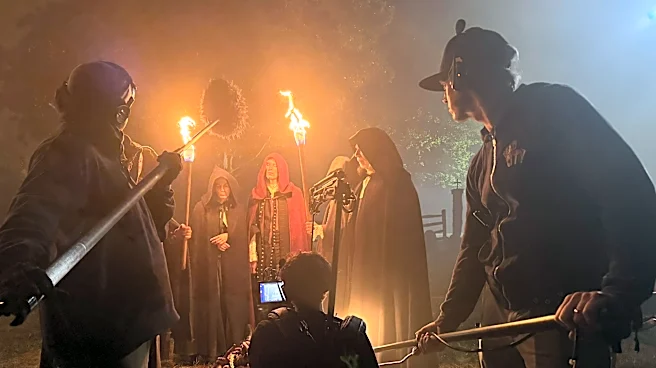
Toward the end of the episode, Richard is being buried alive by the townspeople, who have decided he is in contact with the devil and is cursing their town with this plague. As the townsfolk bury him, he delivers a maniacal monologue about how they’re making a huge mistake.
“We tried to be as realistic and practical as possible, so all of our actors are holding flaming torches, and we’re putting him in a wooden coffin, lowering him down into a grave,” Sprenger notes.
“From the perspective of cinema, it felt like this raw and authentic scene. We tried our best to support that and embrace the natural feeling of how things looked, where people were very dramatically lit from the fire, or the fire was flickering. Instead of trying to sculpt it and fill that in with movie lights, we tried to let it be raw and real and hopefully support the performances.”
Sprenger felt that the show stood out from others since “there was not this overly prescriptive push about how it had to look in the funny moments or in the dramatic moments.”
Instead, Dippold and Murai empowered him and DP Cody Jacobs.
“They really trusted us that we understood what they were after,” he says, crediting that trusted collaboration for the success of the show and its recognition by the Television Academy — the show garnered 19 nominations. “To make great cinema or make great television, or to get nominated for your work, it does take incredible collaboration from supertalented filmmakers all across the board, and trust from Katie and Hiro, and also from Apple to let us make this weird, wacky show.”