
Click here to read the full article.
The logic behind certain prequels is more organic than the logic behind others. The original “Star Wars” was retitled “Star Wars: Episode IV — A New Hope” because it took
place in the middle of something. That made the “Star Wars” prequels a valid idea, even if their execution was subpar.
But the logic behind creating a prequel to “The Hunger Games” series was simply that the franchise was too big to end. And maybe that’s why three years ago, “The Hunger Games: The Ballad of Songbirds & Snakes” was such a stilted, cumbersome travesty of a movie. The film’s storytelling problems went right back to the book (it was the worst of Suzanne Collins’ novels), but the way the book translated to the big screen, it’s as if someone had set forth a challenge: Create a blockbuster movie in which a young man who will grow up to be a famous villain — in this case, Coriolanus Snow — is even less convincing as a seedling of evil than Anakin Skywalker. That’s what “The Ballad of Songbirds & Snakes” brought off. It scored at the box office but was a prequel without psychology, momentum, or dramatic sense.
All of which is to say: “The Hunger Games: Sunrise on the Reaping” had nowhere to go but up. Based on the second of Collins’ two prequel novels, the film is meandering and more than a bit thin, but unlike “The Ballad of Songbirds & Snakes” it’s been directed, by Francis Lawrence, in that lavish mode of surface intensity we might now call Hunger Games Classic. It tells the origin story of Haymitch Abernathy, the champion of the 50th Hunger Games, whom we met in the first “Hunger Games” movie as a drunken, gone-to-seed smart-mouth good guy played by Woody Harrelson. Though it was impossible to believe that blah Tom Blyth would grow up to be sinister President Snow, if you squint hard enough you can half-believe that Joseph Zada, who plays the 16-year-old Haymitch, might one day turn into Harrelson’s dissolute former kid-champion celebrity.
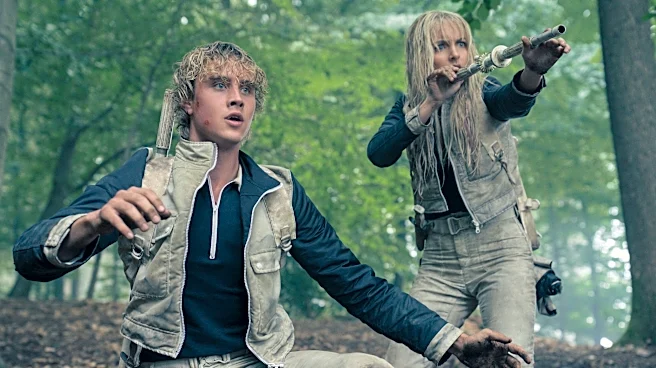
That said, for most of “Sunrise on the Reaping,” Zada, with his two-tone curly blond hair and blue-eyed stare of earnest valor, comes off like a taller version of Christopher Atkins in “The Blue Lagoon.” As he enters the woodland arena and sets about trying to survive the film’s teen-vs.-teen rendition of “The Most Dangerous Truman Show,” he’s the young warrior as pin-up.
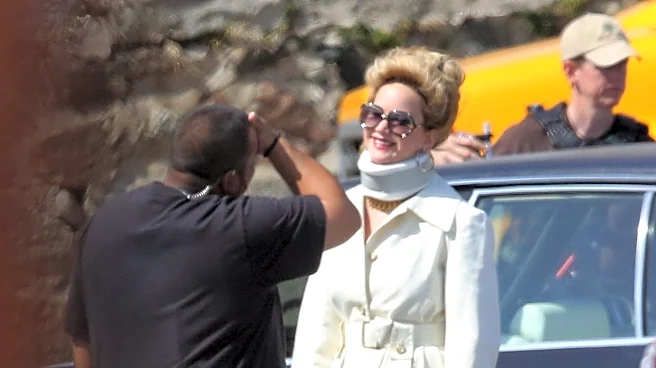
One of the movie’s better scenes is the reaping, which occurs on the same day (each year) as Haymitch’s birthday. There are several violent surprises in it, and Glenn Close has a debauched good time playing Drusilla Sickle, the Capitol escort for the District 12 tributes, who presents as a regal cosmetic-surgery victim who just arrived from Oz on her way to the Met Gala. Haymitch is chosen to be one of District 12’s four tributes to replace the reluctant tribute he tried, valiantly, to save. He will be our hero and tour guide in a movie that essentially replays the plot of the original “Hunger Games” movie.
Haymitch must leave behind his loving girlfriend, Lenore Dove Baird (Whitney Peak), but they’re so devoted to each other that he’s never tempted into a flirtation with Maysilee Donner (Mckenna Grace), one of the two female tributes from District 12. That’s one of many ways the film clamps down on its drama.
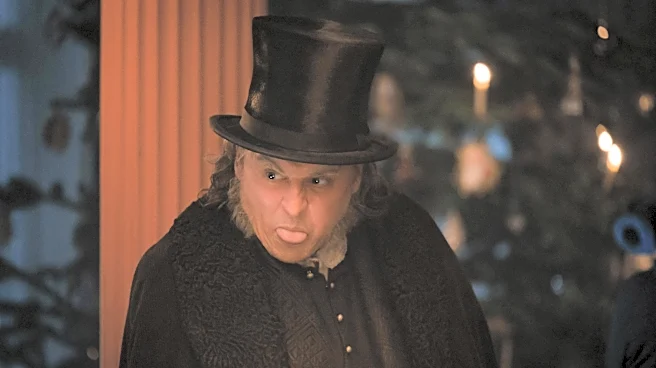
It’s all about the fascist media politics, you see. Kieran Culkin puts on an ugly mustache to play the young Caesar Flickerman (Culkin is fine, but not nearly as stylishly depraved as Stanley Tucci), and Haymitch meets Plutarch Heavensbee (Jesse Plemons), the up-and-coming cameraman for the Hunger Games (the character originally played by Philip Seymour Hoffman). Plutarch’s job is to broadcast, but the crucial thing he does is to edit. What the viewers see at home, from the opening ceremonies onward, is the papered-over fake-news version, with awkward incidents left on the cutting-room floor. Plutarch, though, is also a decent chap who quietly encourages Haymitch to revolt. Haymitch has a close encounter with President Snow, the tyrant of Panem, now played by Ralph Fiennes, who leaves the late Donald Sutherland’s grinning malice behind to play the character like George Washington as a corporate psycho. Haymitch mocked Snow at the opening ceremonies, so Snow has marked him for death. Have no fear: The two will make a deal.
A big part of the folly of the “Hunger Games” prequels is that they’re about the “evolution” of a dystopia…that’s already a dystopia! (How much of a thrill is it to see things slide from bad to a little bit worse?) The excitement, of course, is supposed to be there in the Second Quarter Quell, which opens with Haymitch and the other tributes being fed into a sunlit paradise that looks like the Shire attached to a Disney forest. Haymitch has a bomb he’s going to set off, and the logistics this time involve an erupting volcano and a lot of ominous and mechanical creatures: glittery blue butterflies that can electrocute you, killer rabbits, red birds that attack like something out of “The Birds.”
The movie is, of course, two hours and 38 minutes long, and its distended final section, after Haymitch has won the Games (a reminder for novices: not a spoiler), is devoted to his “tragedy” and the way he devolves into the person Harrelson’s Haymitch will be, in the movie that’s set 24 years after this one. But a sunlit epilogue, featuring famous actors I won’t name, let’s you know: It’s all good. As long as there are no more prequels to “The Hunger Games,” I’d say that’s a fair assessment.