








Click here to read the full article.
Despite the generic title, “Voices” is quite the novelty. Mixing the rarely combined genres of chamber thriller and musical, the film takes place almost entirely in one location — a Detroit motel room in 1967 — and focuses
on just three characters. The actors start singing at the most tense moments, puncturing the perception that, in musicals, characters only break into song to express positive feelings like joy or love. Filmmaker Deanté Gray successfully holds the audience’s attention through this apparent mismatch of genres.
Jordan (Francis Edemobi) is an aspiring singer and musician with dreams of making it big as a Motown star. He makes a living working at a motel that hosts many singers from out of town. When a new and exciting duo, the Harmony Brothers (Joe Maye and Jamal Averett), cross his path, he tries to impress them, hoping they’ll take him along with them and fuel his breakout. Instead, he’s met with derision, before a nasty accident occurs. He calls on his cousin Derrick (Ezekiel Ajeigbe) and Derrick’s girlfriend Mia (Raél Ba) — both also singers — to help him resolve the crisis, and the three decide to parlay this twisted opportunity into a launchpad for their musical careers.
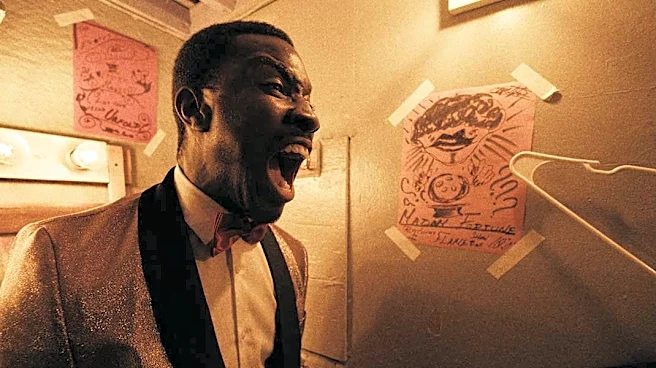
The action never leaves the Harmony Brothers’ motel room until late in the proceedings. Instead, Jordan and his two cohorts spend most the time plotting escape, questioning their motives and ambitions, and making one disastrous decision after another. The screenplay, by Sam Buckner III and Charlie T Savage, heightens every moment to the maximum — and just when you think the tension cannot hold anymore, the characters start to sing. The songs, beautifully written and harmonized, are about strained feelings and regret, making them highly emotional and appropriate to the film’s thriller trappings. At one point, Jordan pours his heart out in song while brandishing a gun. The song is a showstopper; the imagery and implications of the character’s actions give Edemobi much to play with.
The standout performances, however, come from Ajeigbe and Ba, who make for believable lovers and coerced conspirators, always weighing their love for each other and ambition for success against the circumstances they find themselves in. Their rendition of a song titled “The Voices in My Head” is the highlight of the film, encapsulating its sometimes jarring tonal clashes with clarity and tangible emotion. In a smaller part, as one half of the Harmony brothers, Maye proves his talent, giving his character a ferocious temper and distinctive physicality. It’s hard to look elsewhere when he’s in the frame.
All goes well until the script introduces a few more complications. Two extraneous characters appear, and instead of continuing as a morality play, the film suddenly tries to add social and historical context, and the central conceit shifts from personal ambition to the experience of being Black in 1960s America. Sociopolitical context can deepen a story, but here it feels tacked on, as if the writers weren’t sure how else to escalate the action as the film moves toward its denouement.
The bodies start piling up, and the friction between the thriller and musical elements that was so enjoyable earlier begins to fade as the story heads toward an increasingly outlandish conclusion. Still, the editing remains brisk and makes good use of the film’s limited locations, capturing them from different angles and points of view.
Even if it becomes difficult to believe, then, “Voices” remains watchable, with enough invention to make it an intriguing experiment. Gray understands that the musical numbers work best when they emerge from the characters’ fear, desperation and conflicted ambitions rather than interrupting the thriller’s momentum. When the film stays focused on its three central characters, the unusual blend of genres gives it an energy of its own. Later turns may strain credibility, but the performances and songs keep the film grounded in recognizable feeling. Edemobi, Ajeigbe and Ba bring enough warmth and tension to their characters to make their increasingly desperate situation compelling. “Voices” may not fully reconcile its competing impulses, but its willingness to take such an unusual swing makes it difficult to dismiss.