
What's Happening?
A recent discovery of fossils in southwestern China is challenging the established timeline of when complex animal life evolved. Traditionally, the Cambrian explosion, occurring around 539 million years ago, is considered the period when diverse and complex animal life rapidly
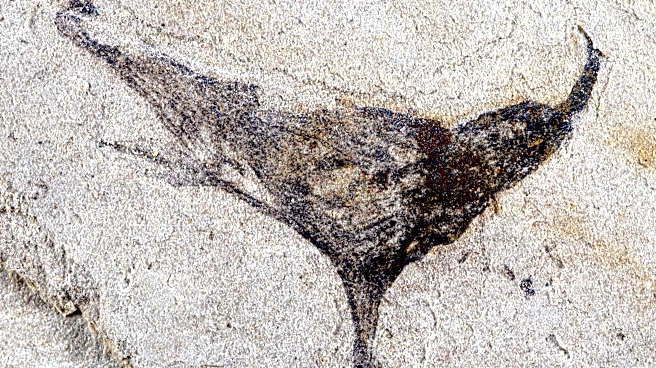
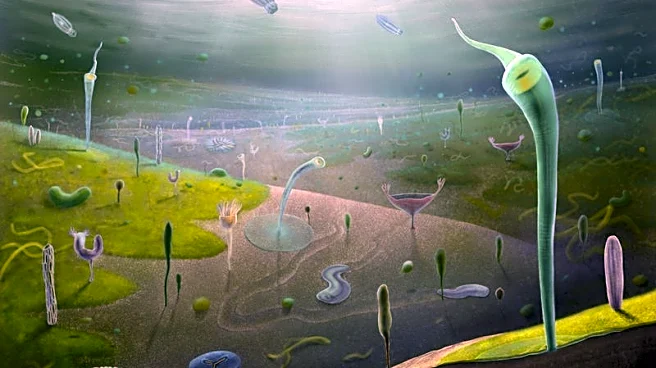
emerged. However, the newly found fossils, dating back to the late Ediacaran period (approximately 635 to 539 million years ago), indicate that complex life forms existed several million years before the Cambrian explosion. The fossils include bilateral worm-like animals, early comb jellies, and relatives of starfish and sea cucumbers. These findings were reported in the journal Science and suggest that the complexity of life forms during the Ediacaran period was greater than previously thought.
Why It's Important?
This discovery has significant implications for our understanding of evolutionary biology. It suggests that the evolutionary processes leading to complex life forms began earlier than the Cambrian explosion, which has been a pivotal point in the study of life's history on Earth. The presence of complex organisms in the Ediacaran period could lead to a reevaluation of the evolutionary timeline and the conditions that facilitated the emergence of complex life. This could impact various scientific fields, including paleontology and evolutionary biology, by providing new insights into the origins and development of life on Earth.
What's Next?
The findings from the Jiangchuan Biota collection may prompt further research into other Ediacaran sites to search for similar evidence of complex life. Scientists may focus on exploring different preservation methods that could reveal more about the soft tissues of ancient organisms, which are often not preserved in fossil records. This could lead to new discoveries that further illuminate the evolutionary history of life on Earth.
Beyond the Headlines
The discovery raises questions about the preservation of fossils and how it affects our understanding of ancient life. The carbonaceous films found at the Jiangchuan site, which capture details of soft tissues, suggest that similar complex life forms might have existed elsewhere but were not preserved due to different fossilization conditions. This highlights the importance of preservation methods in paleontological research and could lead to new techniques for uncovering ancient life forms.