
What's Happening?
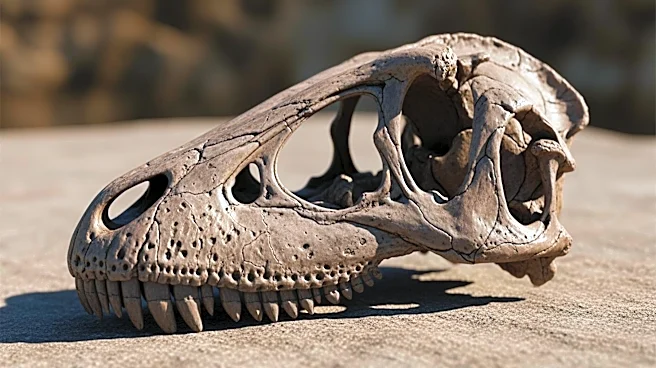
A new genus and species of carnivorous dinosaur, named Ptychotherates bucculentus, has been identified from a well-preserved skull found in northern New Mexico. This discovery, made in the Coelophysis
Quarry, reveals that this species existed around 201 million years ago during the Rhaetian stage of the Triassic period. The skull, measuring approximately 22 cm in length, indicates a dinosaur with a tall, narrow head and massive cheekbones. This species belongs to the Herrerasauria family, one of the earliest-evolving groups of carnivorous dinosaurs. The presence of Ptychotherates bucculentus suggests that some early dinosaur lineages persisted longer than previously thought, surviving until just before the mass extinction at the end of the Triassic period.
Why It's Important?
The discovery of Ptychotherates bucculentus is significant as it challenges previous assumptions about the extinction of early dinosaur lineages. It suggests that some groups of early dinosaurs survived longer than expected, particularly in low-latitude regions of the ancient supercontinent Pangea. This finding forces a reevaluation of the impact of the end-Triassic extinction, indicating that it may have wiped out not only competitors to dinosaurs but also some long-standing dinosaur lineages. The research highlights the diversity and evolutionary adaptability of early dinosaurs, providing new insights into their survival and extinction patterns.
What's Next?
Further research and analysis of the fossilized remains of Ptychotherates bucculentus and other related species could provide more detailed insights into the evolutionary history of early dinosaurs. Paleontologists may continue to explore the Coelophysis Quarry and other similar sites to uncover additional fossils that could shed light on the diversity and distribution of early dinosaur species. This discovery may also prompt a reexamination of other Triassic fossil sites to better understand the global distribution and survival strategies of early dinosaurs.