



What's Happening?
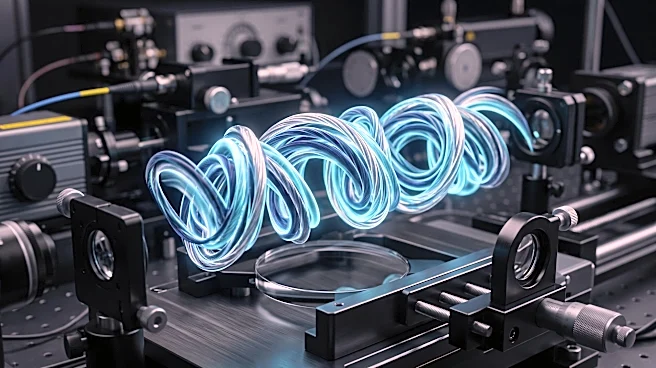
Researchers have successfully generated spatiotemporal optical coils (STOCs) that exhibit controllable transverse intensity chirality. This new form of structured light is created by the non-collinear collision of two spatiotemporal optical vortices (STOVs).
Unlike conventional optical chirality, which relies on polarization or phase, the chirality in these STOCs is directly embedded within the intensity distribution of the light field. When two STOV beams intersect at a specific propagation angle, they produce a coil-like structure where the trajectory of secondary vortices forms a three-dimensional helix. The number of helical arms in the STOC is determined by the difference in topological charges of the colliding STOVs, while the coil's pitch is influenced by both the collision angle and the topological charge difference. This phenomenon allows for the creation of multi-arm spirals, such as double helices or six-arm helices, depending on the input STOV parameters. The research highlights that the energy flow within these STOCs exhibits a complex, braided structure, leading to a non-zero energy-flow helicity density, a key indicator of this novel 3D intensity-twisted topology.
Why It's Important?
This development is significant because it introduces a new paradigm for optical chirality, moving beyond traditional methods that rely on spin angular momentum or phase. By inscribing chirality directly into the intensity distribution, researchers have created a more tangible and engineerable field property. This intensity-driven chirality has profound physical relevance, particularly in the realm of light-matter interactions. The local chiral density, quantified by the energy-flow helicity density, directly influences the mechanical response of chiral particles, offering a new parameter for controlling chiral interactions and particle manipulation. This could lead to advancements in enantio-selective excitation, where specific chiral molecules can be selectively excited or manipulated based on their handedness. Furthermore, the ability to program STOV topology with volumetric richness opens up unprecedented avenues in chiral photonics, potentially impacting fields such as advanced optical trapping, high-dimensional information encoding, and the development of novel optical devices that can precisely control light-matter interactions at a fundamental level.
What's Next?
The immediate next steps in this research will likely involve further characterization and optimization of the generated spatiotemporal optical coils. Researchers will aim to explore the full range of tunability for the helical arms and pitch, as well as investigate the precise mechanisms by which these intensity-chiral fields interact with various types of matter, particularly chiral nanoparticles and molecules. Future work may also focus on developing practical applications for these STOCs, such as designing more sophisticated optical traps for precise manipulation of biological samples or creating new methods for high-density data storage and transmission using the additional degrees of freedom offered by 3D structured light. The ability to control chirality through intensity could also lead to the development of novel optical sensors and spectroscopic techniques that are highly sensitive to molecular handedness, opening new possibilities in chemistry, biology, and materials science.
Beyond the Headlines
This breakthrough extends beyond immediate applications by fundamentally altering our understanding of light's properties and its interaction with matter. The concept of intensity-induced chirality, where the helicity stems from the three-dimensional torsion of energy flow rather than just phase or polarization, represents a significant conceptual leap. This approach draws parallels to the current-density-defined chirality of an electronic coil, suggesting a deeper connection between optical and electronic phenomena. Ethically, the enhanced precision in manipulating chiral particles could have implications for drug discovery and targeted therapies, where the handedness of molecules often dictates their biological activity. Legally, as these technologies advance, intellectual property surrounding novel methods of light manipulation and their applications will become increasingly important. Culturally, this research pushes the boundaries of what is possible with light, potentially inspiring new artistic and scientific endeavors that leverage the complex, three-dimensional structuring of light fields to create novel visual and functional outcomes.