





What's Happening?
Republican U.S. Senate candidate Mike Rogers has publicly advocated for a one-year moratorium on new data center developments across Michigan. This announcement follows reports detailing Rogers' financial investments in companies poised to benefit from
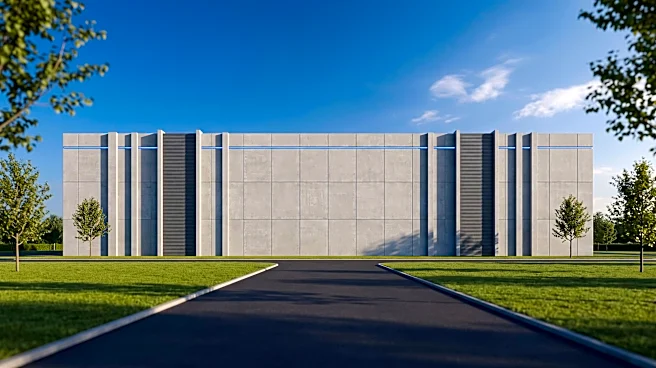
the growth of artificial intelligence (AI) and data center infrastructure. Specifically, Rogers holds between $100,001 and $250,000 worth of Blackstone Real Estate Income Trust, which has significantly increased its data center portfolio and is involved in developing a $16 billion data center near Ann Arbor, Michigan. Additionally, Rogers and his wife, Kristi Clemens Rogers, possess stock and investments in various tech companies leveraging AI, including cybersecurity firms and a quantum computing firm. Rogers also serves as a board advisor for Forgepoint Capital, a venture capital firm invested in numerous AI-related tech companies. His campaign has also received significant donations from individuals with AI and data center investments. This shift in stance comes as data centers become a prominent issue in the Michigan Senate race, with concerns rising about their impact on local communities and resources.
Why It's Important?
The call for a moratorium on data centers by a prominent U.S. Senate candidate highlights the growing tension between technological advancement and local community concerns. Data centers, while crucial for AI and digital infrastructure, are energy-intensive and require substantial water resources, raising fears of increased utility costs for residents and potential strain on Michigan's water supply, including the Great Lakes. The revelation of Rogers' financial ties to the very industry he now seeks to regulate introduces questions of potential conflicts of interest and transparency in political decision-making. This issue is particularly salient in Michigan, where a significant portion of the population relies on groundwater, making them vulnerable to water depletion and contamination. The debate also underscores broader national discussions about the environmental impact of AI infrastructure and the need for responsible development, especially as the industry seeks to streamline permitting processes. The outcome of this debate could set precedents for how states balance economic development with environmental protection and community welfare.
What's Next?
The proposed one-year moratorium on new data center developments in Michigan will likely become a central point of discussion in the ongoing U.S. Senate race. Political leaders, businesses, and civil society groups are expected to react to Rogers' proposal, potentially leading to legislative efforts to implement such a moratorium or to establish new regulations for data center construction and operation. Stakeholders, including AI companies and real estate investment trusts, may lobby against stricter regulations, emphasizing the economic benefits and job creation associated with data center expansion. Conversely, environmental advocacy groups and local communities are likely to support the moratorium, pushing for more stringent environmental safeguards and transparency in development projects. The debate will also likely focus on how to ensure that residential ratepayers are not burdened with increased electricity costs and that water resources are protected. The upcoming election will serve as a critical juncture for voters to weigh in on these issues, influencing the future landscape of AI infrastructure development in Michigan.
Beyond the Headlines
The controversy surrounding data center development in Michigan, and Mike Rogers' evolving stance, reveals deeper implications regarding the intersection of technology, politics, and environmental stewardship. The lack of transparency, often enforced through non-disclosure agreements (NDAs) with local officials, raises ethical concerns about informed public discourse and democratic decision-making. The potential for increased 'forever chemicals' (PFAS) in drinking water due to data center operations, as highlighted by reports, points to long-term public health risks that extend beyond immediate utility costs. This situation also reflects a broader national challenge: how to integrate rapidly advancing technologies like AI without compromising environmental integrity or exacerbating social inequalities. The push for streamlined permitting processes by the AI industry, coupled with calls to modernize environmental protection rules, suggests a potential shift in regulatory frameworks that could have lasting consequences for environmental safeguards. This debate could trigger a re-evaluation of how states and the federal government balance economic growth with the protection of natural resources and community well-being, potentially leading to new models for responsible technological development.