





What's Happening?
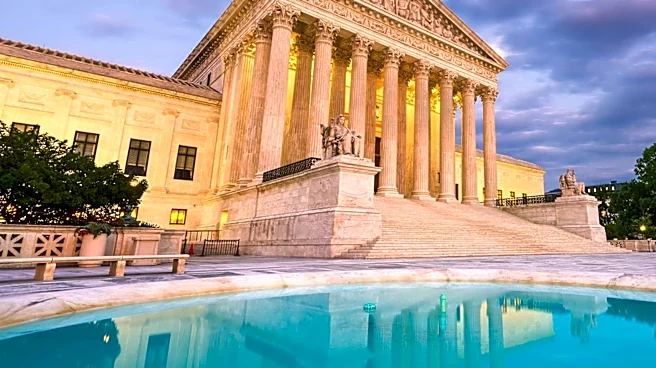
A coalition of multifaith families has petitioned the U.S. Supreme Court to intervene in a case challenging a Texas law that mandates the display of the Ten Commandments in public elementary and secondary school classrooms. The families, representing
various religious and non-religious beliefs, are appealing a decision by the 5th U.S. Circuit Court of Appeals, which upheld Texas Senate Bill 10. This law, enacted last year, requires a poster of the Ten Commandments to be visibly displayed in every public school classroom in the state. The families argue that this requirement violates the First Amendment's ban against the government establishing a religion, citing the Supreme Court's 1980 decision that struck down a similar Kentucky law. The 5th Circuit, however, contended that the legal reasoning behind the 1980 decision was superseded by the Supreme Court's 2022 opinion supporting a high school football coach's prayer at games. Texas Attorney General Ken Paxton has defended the law, stating that the Ten Commandments have profoundly impacted the nation and that students should learn from them daily.
Why It's Important?
This case is significant as it directly challenges the separation of church and state in public education, a foundational principle of the U.S. Constitution. A Supreme Court decision to hear the appeal could reaffirm or redefine the boundaries of religious expression in public schools. If the Court declines to hear the case, it could embolden other states to enact similar laws, potentially leading to a proliferation of religious mandates in public education. The outcome will impact how religious education is perceived and implemented in public institutions, affecting students from diverse backgrounds. For families, it raises questions about parental rights in directing their children's religious upbringing versus state-mandated religious displays. The legal arguments hinge on interpreting past Supreme Court rulings, particularly the 1980 decision on a similar Kentucky law and more recent decisions concerning religious rights in public settings. The case also highlights the ongoing tension between religious freedom and the establishment clause of the First Amendment.
What's Next?
The Supreme Court will decide whether to hear the appeal from the multifaith families. If the Court agrees to take the case, it will likely be scheduled for arguments in a future term, potentially leading to a landmark decision on religious displays in public schools. Regardless of whether the Court hears this specific case, it has already agreed to hear another case in its upcoming October term concerning religious rights and the separation of church and state. This case will debate whether Catholic preschools in Colorado must admit LGBTQ+ families to participate in a state tuition-free program. The outcome of that case could further influence the legal landscape surrounding religious freedom and anti-discrimination laws. Major stakeholders, including civil liberties groups like Americans United for Separation of Church and State, the American Civil Liberties Union, and the Freedom From Religion Foundation, are actively involved in representing the Texas families and will continue to monitor and engage in these legal battles.
Beyond the Headlines
The deeper implications of this case extend to the broader cultural and ethical debate surrounding the role of religion in public life and education. The push to display the Ten Commandments in classrooms reflects a segment of society's desire to reintroduce religious tenets into public institutions, viewing them as essential for moral values. Conversely, opponents argue that such displays can create an exclusionary environment for students of different faiths or no faith, potentially leading to feelings of alienation and discrimination. This legal challenge underscores the ongoing struggle to balance religious freedom with the constitutional mandate of governmental neutrality towards religion. The outcome could set a precedent for how public schools navigate religious diversity and inclusion, influencing curriculum development, classroom environments, and the overall educational experience for millions of students across the U.S. It also highlights the evolving interpretation of the First Amendment in a diverse and pluralistic society.