




What's Happening?
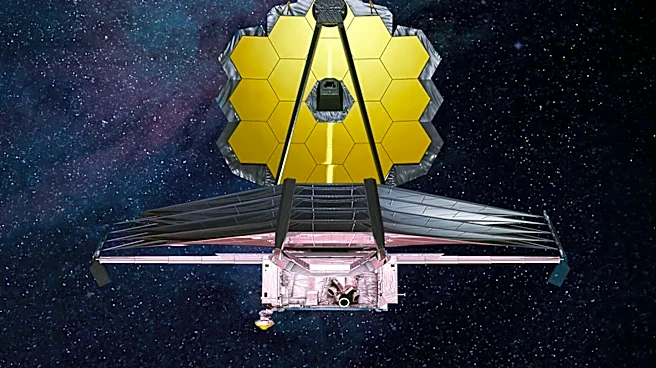
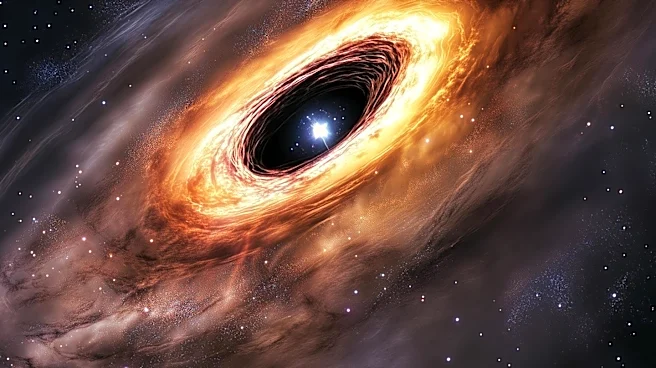
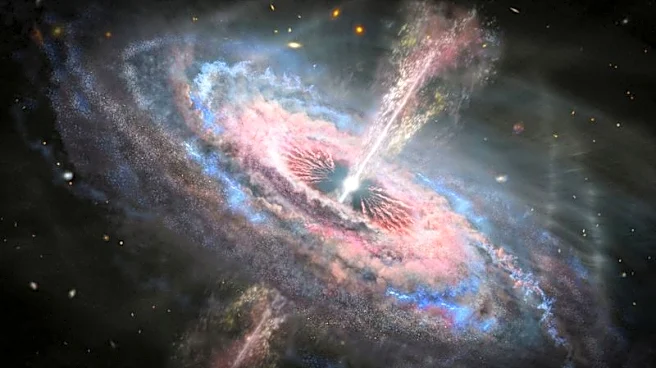
A supermassive black hole, named RBH-1, has been observed moving at nearly 1,000 kilometers per second after being ejected from its galaxy. This discovery was made by a team led by Pieter van Dokkum from Yale University, using the James Webb Space Telescope.
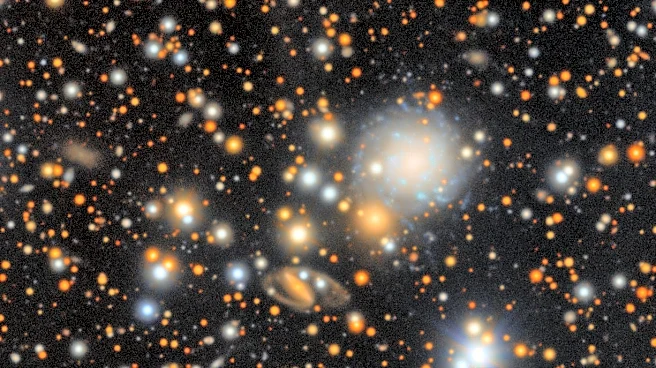
The black hole's movement has left a 200,000-light-year trail of newborn stars. The phenomenon was first noticed in a Hubble image in 2023, but recent data from the James Webb Space Telescope confirmed the black hole's velocity and trajectory. The black hole's mass is estimated to be at least ten million solar masses, possibly up to twenty million, based on the stellar mass of the galaxy it left.
Why It's Important?
This discovery is significant as it provides the first confirmed case of a runaway supermassive black hole, a phenomenon predicted by astronomers for decades. The event offers insights into the dynamics of galaxies and the potential for black holes to be ejected. Understanding such occurrences can help scientists learn more about galaxy formation and evolution. The trail of stars formed in the wake of the black hole also presents a unique opportunity to study star formation under extreme conditions. This could have implications for our understanding of how stars and galaxies evolve over time.
What's Next?
Future observations with wide-field space telescopes like Euclid and the Nancy Grace Roman Space Telescope may reveal more runaway black holes, helping to determine how common such events are. This could lead to a better understanding of the frequency and conditions under which galaxies eject their central black holes. Additionally, further study of the star trail could provide more data on the processes involved in star formation in such unique environments.
Beyond the Headlines
The discovery raises questions about the mechanisms that can eject a black hole from its galaxy. Theories include gravitational wave recoil from a merger or a three-body interaction. Understanding these processes could provide deeper insights into the gravitational dynamics within galaxies. The event also highlights the capabilities of modern telescopes like the James Webb Space Telescope in uncovering new cosmic phenomena.