
What's Happening?
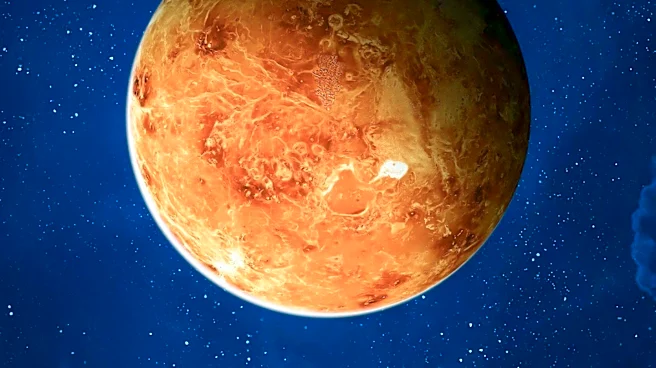
A recent reanalysis of data from NASA's 1978 Pioneer Venus mission suggests that the planet's clouds may contain about 60% water by mass, contrary to the long-held belief that they are primarily composed of concentrated sulfuric acid. This finding, published
in a peer-reviewed journal, indicates that the clouds may also contain ferric sulfate and sulfuric acid, each contributing roughly 20%. The study's authors argue that the data, collected accidentally by the Pioneer Venus probe, may point to a more complex chemical composition of the clouds than previously thought.
Why It's Important?
This discovery could have significant implications for our understanding of Venus's atmospheric chemistry and the potential for habitability. While the presence of more water does not necessarily make the clouds habitable, it challenges the existing model of Venus's atmosphere and suggests that the chemical conditions may be more varied. This could influence future missions and research focused on Venus, as scientists seek to understand the planet's climate and potential for life.
What's Next?
Further research and missions are needed to confirm these findings and explore their implications. NASA's upcoming DAVINCI mission, planned for the early 2030s, aims to send a probe to Venus to measure atmospheric chemistry and collect more detailed data. A purpose-built aerosol instrument could provide more definitive answers about the composition of Venusian clouds and their potential for supporting life.