




What's Happening?
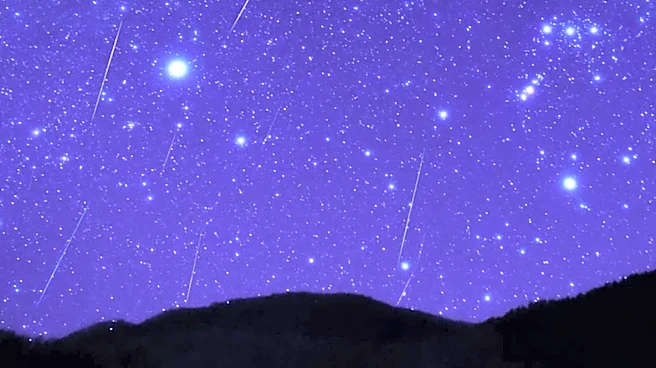
The Perseids meteor shower is currently active, with its peak expected around the night of August 12-13. This annual celestial event occurs as Earth passes through the debris trail left by Comet 109P/Swift-Tuttle. The Perseids are notable for producing
a higher number of fireballs compared to other meteor showers. The radiant point, from which the meteors appear to originate, is located in the constellation Perseus. Optimal viewing conditions are typically after midnight and continue until dawn. The visibility of meteors can vary significantly based on the observer's location, with rural areas generally offering superior views due to reduced light pollution. The parent body, Comet Swift-Tuttle, has a nucleus approximately 26 kilometers wide and orbits the sun every 133 years.
Why It's Important?
The Perseids meteor shower holds significance for both amateur astronomers and the general public, offering an accessible and often spectacular natural phenomenon. Its consistent annual appearance provides a reliable opportunity for sky-gazing, fostering public interest in astronomy and space science. The shower's propensity for producing fireballs, which are exceptionally bright meteors, enhances its appeal and can lead to widespread public engagement. For scientific research, observing meteor showers like the Perseids allows scientists to study the composition and behavior of cometary debris as it interacts with Earth's atmosphere. This provides valuable data on the materials present in comets and the dynamics of our solar system, contributing to a broader understanding of cosmic phenomena without the need for costly space missions.
What's Next?
Following the peak on August 12-13, the Perseids meteor shower will continue to be active, though with diminishing intensity, until approximately August 24. Enthusiasts and the public can still observe meteors during this period, particularly in the days immediately following the peak. Future meteor shower forecasts will continue to be updated annually by organizations like the International Meteor Organization (IMO), providing details on peak times, expected rates (ZHR), and lunar conditions that might affect visibility. Observers are advised to seek locations away from city lights and allow their eyes to adjust to the darkness for the best viewing experience. The next major meteor showers will include the Orionids in October and the Geminids in December, each offering unique characteristics and viewing opportunities.
Beyond the Headlines
The study of meteor showers extends beyond mere observation, offering insights into the origins of our solar system. Each meteor is essentially a free sample of material from a comet or asteroid, providing scientists with direct evidence of extraterrestrial matter. Analyzing the light emitted by meteors as they burn up in the atmosphere can reveal their chemical composition, including organic materials, which are crucial for understanding the building blocks of life. Automated camera networks globally record millions of meteors, enabling researchers to calculate their orbits, identify new streams, and even discover asteroids that disintegrate near the sun. This ongoing research contributes to our knowledge of cosmic dust's impact on Earth's upper atmosphere and the broader celestial environment, highlighting the continuous interaction between our planet and the wider cosmos.