



What's Happening?
Recent research by Dr. Morwenna Blewett, a British historian and associate member of Worcester College at the University of Oxford, has uncovered the involvement of paper restorers and bookbinders in aiding the Nazi regime during the Holocaust. According
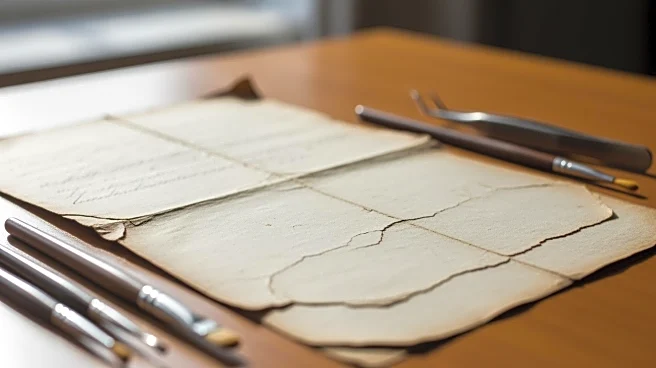
to a Guardian investigation, these conservators were recruited in the 1930s and 1940s to repair and clean centuries-old church and civil registers. This work enabled the Nazis to trace Jewish ancestry, including Christians married to Jews and descendants of converts to Christianity. The restored records of births, baptisms, marriages, and conversions were used to establish inherited 'racial' status. Documents found in German federal archives reveal the complicity of these professionals, who worked both in Germany and in occupied countries, in creating records that could potentially lead to the identification and persecution of Jews.
Why It's Important?
This revelation highlights a lesser-known aspect of the Holocaust, where technical expertise in document restoration was exploited to further the Nazi regime's racial policies. The findings underscore the extent of collaboration and complicity among various professionals in supporting the regime's genocidal agenda. By making fragile documents readable, these restorers inadvertently contributed to the creation of a 'hit list' of individuals based on racial purity. This research not only sheds light on the historical role of conservators but also raises ethical questions about the responsibilities of professionals in times of moral crisis. The study serves as a reminder of the importance of ethical standards in professional practices, especially in contexts where such work can have far-reaching and devastating consequences.
What's Next?
Dr. Blewett's findings are detailed in her new book, 'Art Restoration Under the Nazi Regime,' which explores the technical methods used by restorers and the implications of their work. The publication of this book may prompt further academic and public discourse on the role of professionals in historical atrocities. It could also lead to a reevaluation of the ethical guidelines governing the field of conservation and restoration. As more historical documents are digitized and made accessible, there may be increased scrutiny of the roles played by various professionals during the Holocaust, potentially leading to new insights and understandings of this period.
Beyond the Headlines
The involvement of paper restorers in the Nazi regime's racial policies highlights the complex interplay between technical expertise and ethical responsibility. This case illustrates how specialized skills can be co-opted for harmful purposes, raising questions about the moral obligations of professionals. The research also points to the long-term impact of such actions, as the reputations of those involved remained largely intact despite their contributions to the regime's criminal policies. This underscores the need for ongoing reflection and dialogue about the ethical dimensions of professional work, particularly in fields that intersect with historical and cultural preservation.