



What's Happening?
A team of researchers, including astrophysicist Heino Falcke, quantum physicist Michael Wondrak, and mathematician Walter van Suijlekom, have proposed a new theory regarding the end of the universe. Their study suggests that not only black holes but also
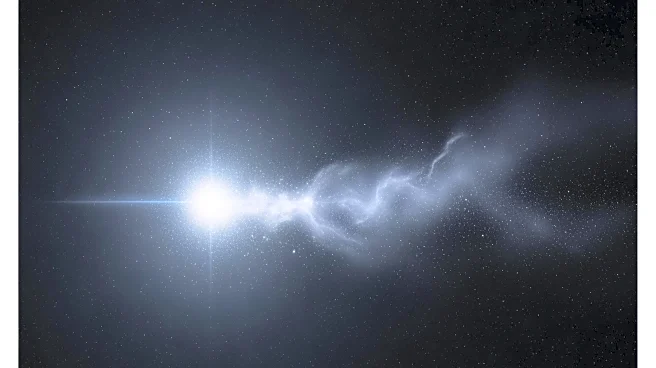
other ultradense objects like white dwarf stars and neutron stars could evaporate through a process similar to Hawking radiation. This process involves the formation of quantum-entangled particles, where one particle escapes into space while the other remains. The researchers argue that this evaporation could occur much sooner than previously thought, potentially reducing the universe's lifespan to 10^78 years, a significant decrease from the earlier estimate of 10^1100 years. This hypothesis was published in the Journal of Cosmology and Astroparticle Physics.
Why It's Important?
The implications of this study are profound for our understanding of the universe's longevity and the processes governing its eventual demise. If the universe's end is indeed closer than previously believed, it could reshape theoretical physics and cosmology, prompting a reevaluation of how we perceive time and space. The potential for other dense objects to evaporate like black holes challenges existing models and could influence future research directions. This theory also raises questions about the fate of matter and energy in the universe, impacting scientific discourse on topics ranging from quantum mechanics to astrophysics.
What's Next?
Further research is needed to validate these findings and explore their implications. Scientists may conduct additional studies to observe and measure the evaporation processes of dense objects in space. This could involve advanced simulations or observations using next-generation telescopes. The scientific community will likely engage in debates and discussions to assess the validity and impact of this new theory. If confirmed, this could lead to a paradigm shift in our understanding of cosmic evolution and the ultimate fate of the universe.
Beyond the Headlines
This development touches on deeper philosophical and existential questions about the nature of existence and the universe's ultimate fate. It challenges the notion of permanence and highlights the transient nature of all matter. The study also underscores the interconnectedness of quantum mechanics and cosmology, suggesting that even the most massive and dense objects are not immune to the fundamental laws of physics. This could inspire new lines of inquiry into the nature of reality and the potential for life beyond our solar system.