


What's Happening?
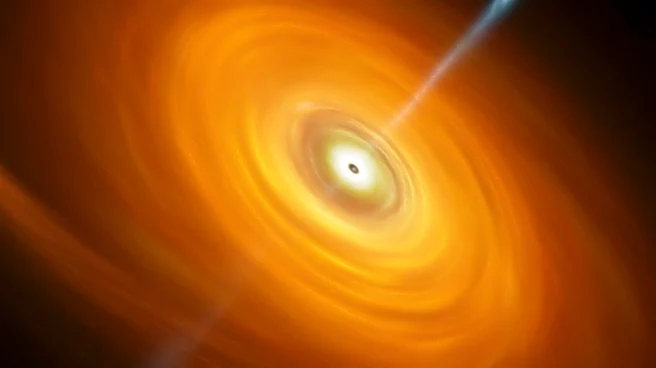
Researchers at Syracuse University have identified stellar spin as a key factor in explaining why black hole flares, resulting from stars making repeated close passes to supermassive black holes, progressively dim over time. This study, published in The
Astrophysical Journal, addresses a long-standing mystery in astrophysics concerning repeating partial tidal disruption events (rpTDEs). While previous models suggested that even with decreasing material loss, flares should maintain similar brightness due to the black hole's tidal forces causing the star to spin faster, the new research introduces the concept of a star already spinning rapidly before its initial encounter. This pre-existing rapid rotation prevents significant additional spin-up during subsequent passes, allowing the rate of material fallback to remain relatively constant. Consequently, as less material is stripped away with each encounter, the peak fallback rate and the predicted brightness of the flare decline, aligning with astronomical observations of dimming flares.
Why It's Important?
This research significantly advances the understanding of black hole dynamics and star-black hole interactions, particularly in the context of tidal disruption events. By solving the puzzle of dimming flares, it refines theoretical models and provides a more accurate framework for interpreting observational data from rpTDEs. This improved understanding is crucial for astronomers who rely on these events to indirectly study otherwise invisible black holes. The findings also shed light on the origins of stars in the vicinity of supermassive black holes, such as Sagittarius A* in the Milky Way. The proposed 'Hills mechanism,' where a binary star system is torn apart by a black hole, with one star ejected and the other captured, offers a plausible explanation for both the rapid initial spin of the captured star and its tight orbit. This mechanism could help explain properties of stars in our own galaxy's center, contributing to a broader comprehension of galactic evolution and the extreme environments around supermassive black holes.
What's Next?
The findings from Syracuse University suggest several avenues for future research. Further observational studies will likely focus on identifying more rpTDEs and meticulously tracking their flare brightness over multiple cycles to validate the model. Astronomers may also seek to measure the spin rates of stars involved in these events, which could provide direct evidence supporting the theory. The 'Hills mechanism' hypothesis could be further explored through simulations and by searching for other stars with similar orbital and rotational characteristics around supermassive black holes. Additionally, the refined theoretical models will enable more precise calculations of black hole masses and spins, contributing to a more comprehensive understanding of these cosmic phenomena. The insights gained could also inform the design and interpretation of data from next-generation telescopes and observatories, enhancing our ability to probe the universe's most extreme environments.
Beyond the Headlines
The implications of this research extend beyond the immediate understanding of black hole flares. It highlights the intricate interplay of gravitational forces and stellar properties in extreme cosmic environments. The concept of a star's initial spin being a critical factor underscores the importance of a star's history and formation mechanisms in determining its fate when interacting with a black hole. This work also exemplifies the iterative nature of scientific discovery, where observational anomalies drive theoretical advancements, which in turn guide future observations. The 'Hills mechanism' offers a fascinating glimpse into the violent processes that shape galactic centers, suggesting that many stars in these regions may have originated from disrupted binary systems. This deeper understanding of stellar dynamics near supermassive black holes contributes to the broader narrative of how galaxies form and evolve, and how the most powerful objects in the universe influence their surroundings.