






What's Happening?
China Daily emphasizes the importance of dialogue to prevent differences from destabilizing overall Sino-U.S. economic ties, particularly in the context of intense technological competition. The publication highlights that despite political tensions and
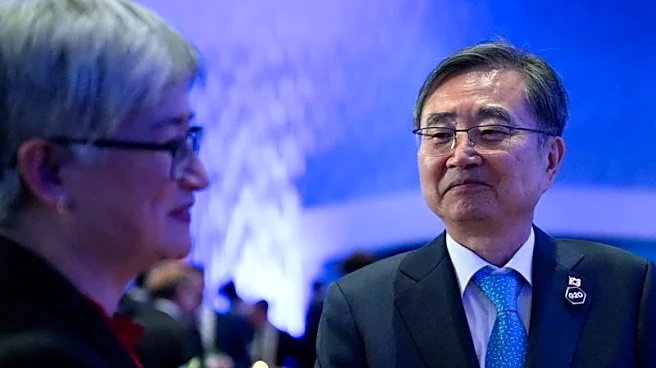
U.S. efforts to impose high-tech restrictions on China, channels between the two countries are still producing tangible results. As an example, it cites the first meeting of the trade council under the China-U.S. economic and trade consultation mechanism, which involved candid exchanges on tariffs, reciprocal tariff reductions on approximately $30 billion worth of goods, and agricultural trade. Chinese Foreign Minister Wang Yi also called for mutual respect, peaceful coexistence, and win-win cooperation to guide efforts in building a constructive China-U.S. relationship. The article suggests that the U.S. administration's rhetoric, such as promoting 'Pax Silica' and linking Chinese AI models to cybersecurity incidents, aims to politicize technological competition and justify restrictions, rather than fostering innovation.
Why It's Important?
This perspective from China Daily underscores Beijing's desire to manage the U.S.-China economic relationship through dialogue and cooperation, even as technological competition intensifies. The emphasis on tangible results from trade discussions, despite broader political storms, suggests a strategic effort to de-escalate tensions in specific economic sectors. The call for mutual respect and win-win cooperation reflects China's long-standing diplomatic approach, aiming to counter what it perceives as U.S. attempts to contain its technological rise. The article's critique of U.S. rhetoric regarding AI and cybersecurity highlights the deep mistrust and differing interpretations of national security concerns that complicate bilateral relations. The ability of both nations to identify shared interests and negotiate workable arrangements, as demonstrated by the trade council meeting, is crucial for global economic stability and preventing a complete decoupling of the world's two largest economies.
What's Next?
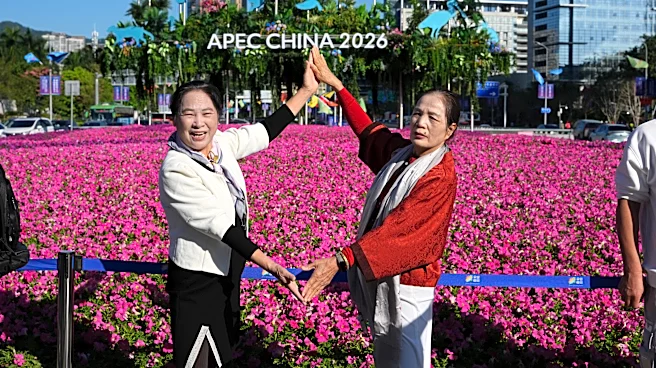
The ongoing dialogue through mechanisms like the trade council and diplomatic meetings will be critical in determining the future trajectory of Sino-U.S. economic relations. China will likely continue to advocate for open trade and technological cooperation, while pushing back against what it views as protectionist measures and politicization of technology. The U.S., on the other hand, is expected to maintain its focus on national security and technological leadership, potentially leading to further export controls and restrictions in strategic sectors. The upcoming APEC meeting, where AI is expected to be a prominent topic, will provide another platform for leaders to engage, though significant breakthroughs on contentious issues like chip export controls may remain elusive. The challenge for both nations will be to expand areas of cooperation while managing their fundamental differences to prevent broader economic destabilization.
Beyond the Headlines
The narrative presented by China Daily reveals a strategic effort to frame the U.S.-China relationship as one where cooperation is possible and necessary, despite competition. By highlighting successful dialogues and tariff reductions, China aims to demonstrate its commitment to global trade and stability, contrasting it with what it portrays as U.S. efforts to disrupt supply chains and create an 'AI monopoly.' This framing is not just for international consumption but also for domestic audiences, reinforcing the idea that China is a responsible global actor. The underlying tension between economic interdependence and strategic competition will continue to shape policy decisions, influencing global trade patterns, technological innovation, and the geopolitical landscape. The long-term implications include the potential for a more multipolar global economic order, where nations increasingly prioritize national interests and technological self-reliance, leading to a complex web of alliances and rivalries.