









What's Happening?
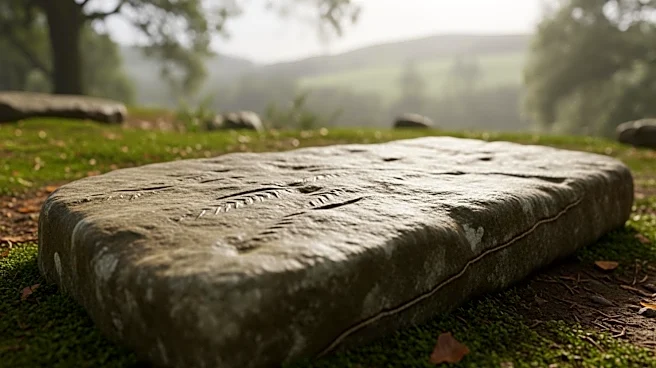
A recent study has shed light on the transportation of Stonehenge's Altar Stone, a 6.6-ton block of grayish-green sandstone, revealing that human effort was essential in moving it from its origin in the far north of Scotland to its current location on Salisbury
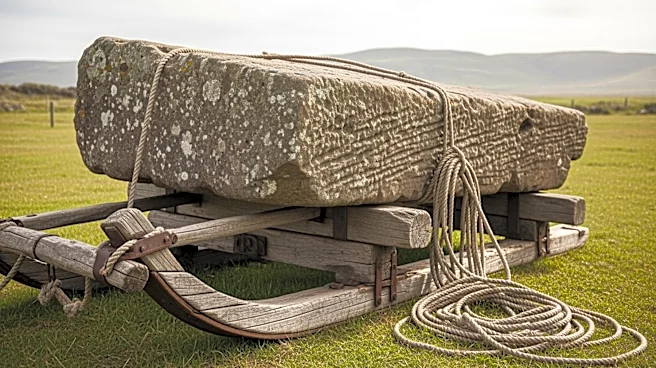
Plain. The research, conducted by geologist Anthony Clarke and his team at Curtin University, indicates that while glaciers may have transported the stone part of the way during the last Ice Age, human intervention was necessary to complete the journey. The study involved analyzing zircon crystals in the stone, tracing its origin to the Orcadian Basin in Scotland, and modeling the flow of the British-Irish Ice Sheet. The findings suggest that the stone was likely moved in stages, possibly using a combination of overland hauling and river or coastal transport.
Why It's Important?
This discovery is significant as it challenges previous assumptions about the construction of Stonehenge and highlights the remarkable ingenuity and determination of ancient humans. Understanding the methods used to transport such massive stones over long distances provides insight into the capabilities and resourcefulness of prehistoric societies. The study also emphasizes the importance of combining geological analysis with computer modeling to resolve historical mysteries. This research not only contributes to the historical understanding of Stonehenge but also underscores the potential for human innovation in overcoming natural obstacles, which can inspire modern engineering and logistical solutions.
What's Next?
Future research may focus on uncovering more details about the specific routes and methods used by ancient people to transport the Altar Stone. Archaeologists and geologists might explore other stones at Stonehenge to determine if similar transportation techniques were employed. Additionally, this study could prompt further investigations into other ancient monuments and the logistics behind their construction, potentially leading to new discoveries about human history and prehistoric engineering practices.
Beyond the Headlines
The study of Stonehenge's Altar Stone also raises questions about the cultural and ceremonial significance of such monumental efforts. The decision to transport a massive stone over hundreds of kilometers suggests a deep cultural or religious motivation, reflecting the values and beliefs of the society that undertook this task. This aspect of the research invites a broader discussion on the role of monumental architecture in ancient societies and its impact on social cohesion and identity.