





What's Happening?
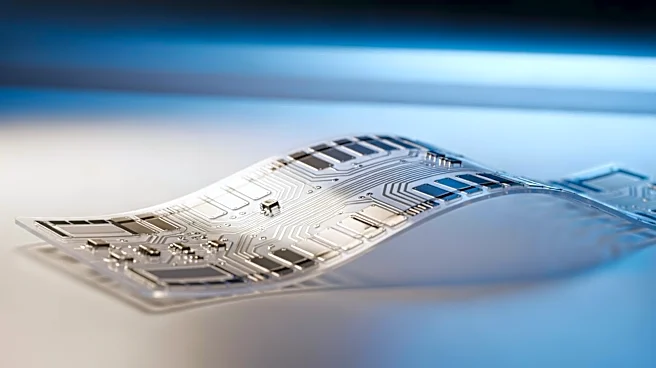
Recent advancements in biotelemetry have introduced a novel method for medical implants that uses near-infrared (NIR) light for wireless communication and energy transfer. A study published in Scientific Reports examined how surface obstructions, such
as clothing, affect the efficiency of optical wireless data and power transfer systems for in-body electronic devices (IEDs). The findings showed that NIR light can effectively penetrate biological tissue and support the operation of IEDs. However, textile layers cause significant signal attenuation, which must be considered in practical medical applications to maintain reliable power delivery and data transmission. The study used an experimental system with commercial off-the-shelf components to simulate real-world conditions, demonstrating that while clothing reduces energy-harvesting performance, the optical communication link remains reliable for essential medical communications.
Why It's Important?
This research is significant for the development of future wearable-to-implant communication systems, particularly for devices requiring regular updates or calibration, such as insulin pumps and drug delivery systems. Understanding how clothing affects optical attenuation allows engineers to design adaptive transmitters that adjust power or modulation methods to compensate for different textile conditions, ensuring reliable operation of medical implants. The study also suggests that ambient solar NIR radiation could serve as an additional energy source, supporting the development of optical harvesting fabrics or wearable patches. These advancements could lead to more efficient, battery-free, light-powered medical implants, enhancing patient care and reducing the need for surgical battery replacements.
What's Next?
Future research will focus on ensuring thermal safety and alignment accuracy, with studies likely investigating real-time temperature monitoring to prevent potential tissue damage from higher LED power levels used to overcome clothing attenuation. Additionally, the effects of different fabric colors and moisture conditions will require further analysis. By improving optical system models and developing advanced synthetic optical phantoms for long-term testing, researchers aim to make optical in-body communication a practical standard for future healthcare systems.