







What's Happening?
Sparta ultimately defeated Athens in the 27-year-long Peloponnesian War (431-404 BC) through a combination of strategic shifts, Athenian missteps, and crucial financial backing from the Persian Empire. Initially, Sparta, a land-based power, struggled
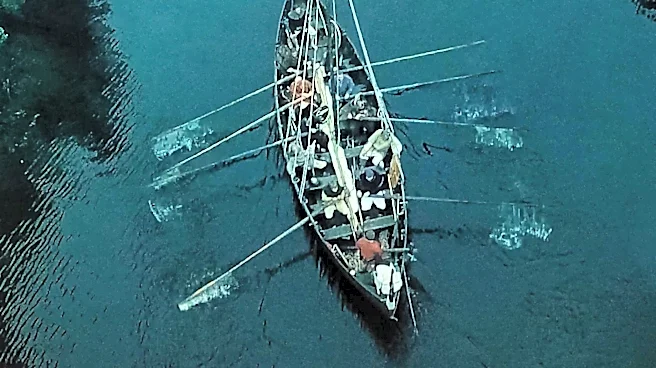
against Athens' dominant navy and fortified city. However, Sparta adapted its strategy, moving away from failed land invasions of Attica to building a powerful fleet capable of challenging Athenian maritime supremacy. This strategic pivot was significantly bolstered by Persian funds, which allowed Sparta to construct and maintain its navy, effectively turning the conflict into a war of resources that Athens, despite its initial wealth, could not sustain. Athenian mistakes, particularly the disastrous Sicilian Expedition between 415 and 413 BC, which resulted in the loss of numerous ships, soldiers, and leaders, further weakened their position. Political instability and internal divisions within Athens also contributed to their eventual defeat, as highlighted by the historian Thucydides, who suggested that the absence of strong leadership after Pericles led to policy decisions driven by personal ambition rather than sound strategy.
Why It's Important?
The Peloponnesian War serves as a historical case study illustrating the critical role of adaptable military strategy, economic resources, and political stability in prolonged conflicts. Sparta's ability to transition from a land-centric military to a formidable naval power, supported by external funding, demonstrates the importance of strategic flexibility in overcoming an adversary's inherent strengths. The war also underscores the impact of economic warfare; Persian gold enabled Sparta to outlast Athens in a costly naval arms race. Furthermore, the Athenian experience highlights how internal political chaos and strategic blunders, such as the overambitious Sicilian Expedition, can lead to the downfall of even a powerful and wealthy state. This historical conflict offers insights into the dynamics of power shifts, the necessity of sound leadership, and the potential for external actors to influence the outcome of major geopolitical struggles, themes that remain relevant in contemporary international relations and military planning.
What's Next?
While the Peloponnesian War concluded over two millennia ago, its historical analysis continues to inform military and political thought. Future studies may further explore the specific economic mechanisms of Persian funding and its precise impact on Spartan naval development, potentially drawing parallels to modern foreign aid and military alliances. Researchers might also delve deeper into the psychological and sociological effects of prolonged warfare on both Athenian and Spartan societies, examining how the conflict reshaped their respective cultures and political ideologies. The role of propaganda, as employed by Sparta to position itself as a liberator, could also be a subject of further examination, offering insights into historical and contemporary information warfare. Additionally, the long-term consequences of Athens' defeat and Sparta's subsequent, albeit brief, hegemony in the Greek world could be re-evaluated to understand the broader trajectory of ancient Greek civilization following this pivotal conflict.
Beyond the Headlines
Beyond the immediate military and political outcomes, the Peloponnesian War had profound and lasting implications for the Greek world, shaping its philosophical, cultural, and political landscape. The war's devastation contributed to a period of instability and decline for the Greek city-states, paving the way for the rise of Macedon. The conflict also spurred significant intellectual developments, particularly in political philosophy, as thinkers like Plato and Aristotle grappled with the failures of Athenian democracy and the nature of ideal governance. Thucydides' detailed account of the war, emphasizing human nature, power politics, and the cyclical nature of conflict, established a foundational text for the study of international relations and historical methodology. The war's ethical dimensions, including the brutal treatment of conquered populations and the moral compromises made by both sides, continue to provoke reflection on the costs of war and the erosion of humanitarian principles during conflict. The shift in power dynamics also led to a re-evaluation of the concept of empire and the responsibilities of dominant states.