

What's Happening?
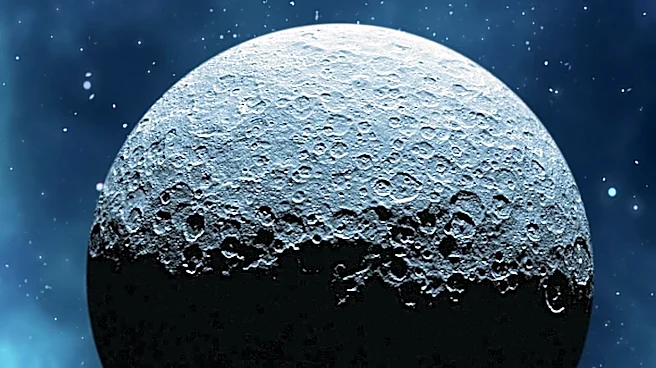
In 2024, an international team of scientists reported the discovery of a global ocean beneath the surface of Mimas, one of Saturn's moons. This finding was unexpected because Mimas's surface appears old, heavily cratered, and shows no obvious signs of geological
activity, unlike other ocean worlds like Enceladus or Europa. The evidence for the ocean came from analyzing tiny details of Mimas's rotational wobble and the precession of its periapsis, using data from NASA's Cassini mission. These movements could only be reconciled by the presence of a liquid layer beneath 20 to 30 kilometers of ice. Crucially, the ocean is estimated to have formed less than 25 million years ago, making it younger than the Himalayas. This youth may explain why Mimas's ancient-looking exterior has not yet betrayed the significant changes occurring beneath its surface.
Why It's Important?
The discovery of a young, hidden ocean on Mimas significantly broadens the search criteria for ocean worlds and potential habitability within our solar system and beyond. Previously, scientists often looked for visible signs of geological activity, such as plumes or fractured terrain, as indicators of subsurface oceans. Mimas demonstrates that a seemingly 'dead' and heavily cratered celestial body can still harbor a dynamic internal environment. This challenges existing assumptions and suggests that many more moons and dwarf planets could potentially host liquid water, even if their surfaces offer no immediate clues. For astrobiology, while Mimas's young ocean is liquid water, a key ingredient for life, its chemical composition, depth, and interaction with rock are still unknown, and its recent formation raises questions about the time available for complex prebiotic chemistry to develop. This discovery necessitates a re-evaluation of how scientists identify and prioritize targets for future exploration.
What's Next?
The discovery of Mimas's young ocean will likely spur further research into its formation and evolution. Scientists will continue to refine models of its interior, focusing on factors like ice viscosity, tidal heating, and orbital changes to better understand how the ocean formed and expanded. The simulations suggest that the ocean-ice boundary reached within 30 kilometers of the surface only in the last 2 to 3 million years, which could explain the lack of surface features. Future missions to the Saturnian system could provide more direct observations to confirm or challenge parts of this picture, potentially through instruments capable of probing subsurface structures. The astrobiological implications will also be a focus, with efforts to determine if the ocean is salty, chemically rich, and in contact with rock, which are crucial factors for assessing its habitability potential. This finding will also influence the design and objectives of future planetary science missions.
Beyond the Headlines
Mimas's hidden ocean presents a compelling case study in the deceptive nature of planetary surfaces. Its appearance, reminiscent of the fictional Death Star, belied a dynamic internal process that has only recently begun. This highlights the importance of indirect measurements, such as celestial mechanics, in revealing the true nature of celestial bodies. The comparison to the Himalayas, a relatively young geological feature on Earth, underscores the rapid and profound changes that can occur within planetary systems. The concept of a 'young ocean' also opens up new avenues for understanding the early stages of ocean world development, potentially offering insights into how other established ocean worlds like Europa and Enceladus may have evolved. This discovery encourages a more nuanced approach to planetary exploration, emphasizing that the absence of obvious surface activity does not equate to a lack of internal dynamism or potential for liquid water.