
What's Happening?
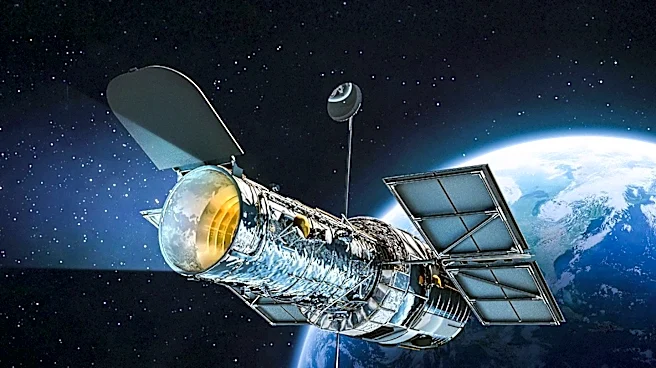
New observations from the Hubble Space Telescope have provided a clearer picture of the 'Cat's Tail,' a trail of soot-dark dust around the young star Beta Pictoris, located 63 light-years away. The study,
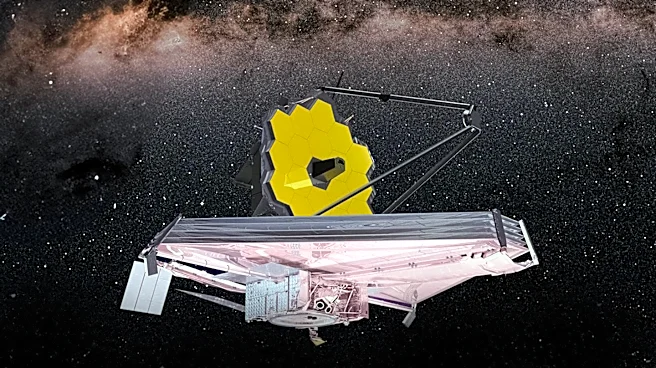
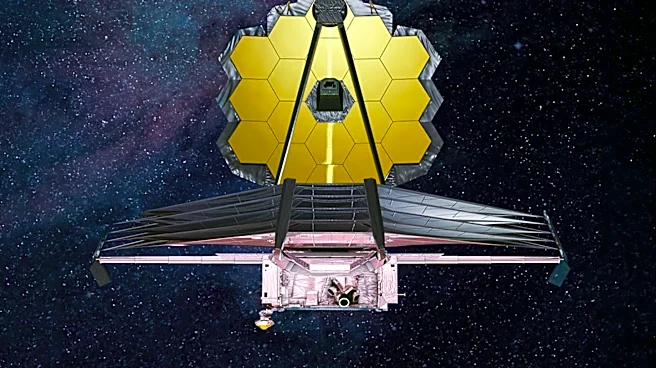
led by University of Arizona doctoral student Arin Avsar, indicates that this dust structure lies mostly flat against the sky from Earth's perspective and is composed almost entirely of porous, carbon-rich grains. These grains are believed to have formed from a collision between two Pluto-sized bodies. The Cat's Tail was initially discovered in 2024 by NASA's James Webb Space Telescope, which detected it in mid-infrared light. Hubble's visible-light images, combined with Webb's infrared data and computer modeling, helped reconstruct the tail's three-dimensional arrangement, revealing its flat orientation and fluffy, carbon-rich composition.
Why It's Important?
The study of Beta Pictoris offers a unique 'live view' into the chaotic processes that shaped our own solar system billions of years ago. Understanding how dust forms and moves in this young system helps scientists reconstruct the early history of the Kuiper Belt beyond Neptune, which is thought to have once held hundreds of Pluto-sized bodies. The discovery of the Cat's Tail's composition and formation mechanism provides crucial data for refining models of planet formation and debris disk evolution. This research, supported by U.S. institutions like the University of Arizona and NASA, enhances our fundamental understanding of astrophysics and planetary science. It sheds light on the violent collisions and gravitational sculpting by giant planets that are integral to the birth of planetary systems, including our own.
What's Next?
While the current study provides a strong hypothesis for the Cat's Tail's origin, the authors note that the mechanism of carbon grain formation remains uncertain and requires further observations for confirmation. Future observations by the James Webb Space Telescope could track whether the tail changes shape over time, which would help confirm its origin and age. Additionally, the unexpected warp found in the broader dust halo around Beta Pictoris, suspected to be caused by the giant planet Beta Pic b, will likely be a subject of further investigation. Continued monitoring of Beta Pictoris will provide ongoing insights into how massive planets can shape dust and icy bodies far beyond their own orbits, offering a dynamic view of planetary system evolution.
Beyond the Headlines
The 'Cat's Tail' discovery highlights the power of combining data from multiple advanced telescopes, such as Hubble and Webb, to achieve a more comprehensive understanding of cosmic phenomena. This collaborative approach is becoming increasingly vital in modern astronomy. The carbon-rich chemistry of the dust also draws parallels to materials found in our own solar system, such as samples returned from asteroid Bennu by NASA's OSIRIS-REx mission, suggesting common processes in planetary formation across different star systems. This research not only expands our scientific knowledge but also underscores the continuous evolution of our universe, reminding us that the processes that formed our home planet are still actively occurring elsewhere, providing a cosmic laboratory for scientific inquiry.