







What's Happening?
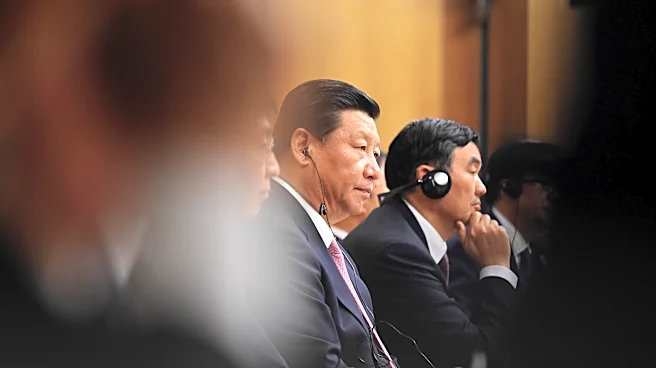
Senior Chinese and North Korean officials recently met in Beijing to deepen their relationship, following North Korean leader Kim Jong-un's visit to the border city of Dandong. According to the South China Morning Post, China's top diplomat Wang Yi hosted
a delegation led by Kim Song-nam, the international affairs chief of the Workers' Party of Korea. Wang Yi expressed China's readiness to work with the Democratic People's Republic of Korea (DPRK) to implement the consensus reached by the leaders of both parties and countries. He emphasized advancing bilateral ties towards deeper, greater, substantive, and better development. This meeting signifies a renewed diplomatic drive between the two nations.
Why It's Important?
This diplomatic engagement between China and North Korea is significant as it reinforces their strategic alliance, potentially reducing the effectiveness of international efforts to isolate North Korea. As reported by The Korea Herald, North Korea has strengthened its economic and military ties with China and Russia in recent years. This deepening cooperation provides Pyongyang with alternative avenues for economic and political support, potentially lessening its reliance on concessions from the United States. For the U.S., this development could complicate future negotiations with North Korea, as Pyongyang may feel less pressure to engage in denuclearization talks if it has robust backing from China. It also highlights the evolving geopolitical landscape in East Asia, where regional powers are solidifying alliances.
What's Next?
The commitment from both China and North Korea to advance bilateral ties suggests a continued strengthening of their relationship. This could manifest in increased economic exchanges, military cooperation, and diplomatic coordination on international issues. For the U.S., this means that any future diplomatic overtures to North Korea will need to consider the enhanced support Pyongyang receives from Beijing. The U.S. may need to adjust its strategies for engaging with North Korea, potentially by seeking greater cooperation from China or by developing new approaches that account for this strengthened alliance. The focus will likely be on monitoring the practical implementation of the 'key consensus' mentioned by Wang Yi and its implications for regional stability.
Beyond the Headlines
The renewed diplomatic drive between China and North Korea carries broader implications for regional security and the balance of power in East Asia. It could signal a more assertive stance from North Korea, emboldened by its alliances, in its dealings with the international community. This could also lead to increased tensions in the region, particularly concerning North Korea's nuclear program and missile tests. The long-term shift could see a more entrenched bloc of nations challenging U.S. influence in the region, potentially leading to a more complex and multipolar international order. The ethical dimension involves the implications of supporting a regime that faces international sanctions and human rights concerns, and how this impacts global efforts to promote peace and stability.