
What's Happening?
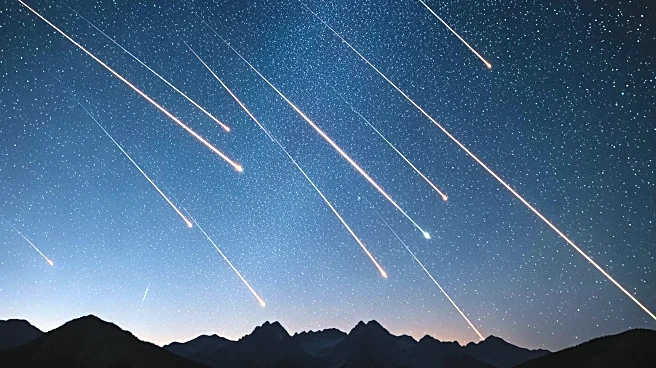
Astrophotographer Josh Dury has captured a stunning image of the Geminid meteor shower, which peaks annually in December. This year, the shower reached its peak around December 13, offering favorable viewing
conditions due to a dim moon. The Geminids are unique among meteor showers as they originate from an asteroid, 3200 Phaethon, rather than a comet. The radiant point of the Geminids is located in the constellation Gemini, near the star Castor. Dury's photograph, taken near the Yucatán Peninsula in Mexico, creatively juxtaposes the meteor shower with fossilized dinosaur tracks, evoking imagery of the asteroid impact that led to the extinction of the dinosaurs.
Why It's Important?
The Geminid meteor shower is one of the most prolific and reliable meteor showers, providing a spectacular natural display that attracts skywatchers worldwide. Its unique origin from an asteroid rather than a comet adds scientific interest, as it challenges the typical understanding of meteor showers. The imagery captured by Dury not only highlights the beauty of the event but also serves as a reminder of Earth's dynamic history and the potential impacts of celestial bodies. This event underscores the importance of continued astronomical observation and public engagement with space phenomena.
What's Next?
As the Geminid meteor shower concludes, astronomers and enthusiasts will prepare for the next major meteor event, the Quadrantids, which peaks in early January. Observatories and astrophotographers will continue to monitor and capture these celestial events, contributing to both scientific research and public interest in astronomy. The ongoing study of meteor showers like the Geminids helps scientists understand the composition and behavior of asteroids and comets, which is crucial for assessing potential future impacts on Earth.
Beyond the Headlines
The Geminid meteor shower's connection to asteroid 3200 Phaethon offers insights into the behavior of asteroids that exhibit comet-like activity. This challenges traditional classifications and prompts further research into the nature of such celestial bodies. Additionally, the cultural and educational impact of meteor showers is significant, as they inspire curiosity and wonder about the universe, encouraging public interest in science and space exploration.