






What's Happening?
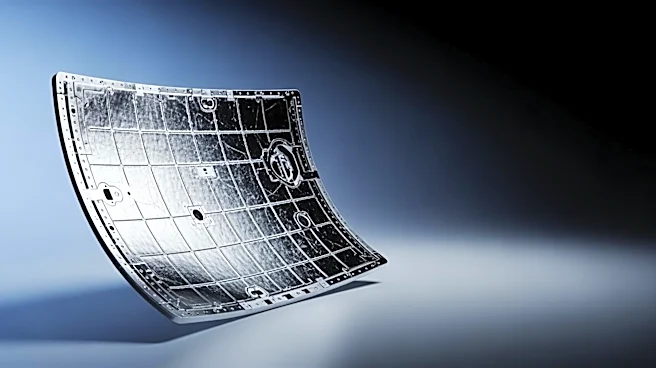
Scientists in Japan have successfully developed a high-resolution X-ray telescope capable of distinguishing objects as small as 3.5 mm from a kilometer away. This breakthrough was achieved by combining precision mirror-making technology with space astronomy.
The telescope was tested using a unique ground-based system that simulates starlight, allowing researchers to measure its sharpness before its launch on the US-Japan FOXSI sounding rocket mission. This development marks a significant achievement in Japanese X-ray astronomy, paving the way for future high-resolution X-ray observations on smaller satellites.
Why It's Important?
The development of this high-resolution X-ray telescope is crucial for advancing our understanding of high-temperature and violent processes in the universe, such as solar flares and black holes, which emit X-rays that cannot be studied from Earth's surface. By enabling precise X-ray observations from space, this technology could significantly enhance scientific research in astrophysics. The collaboration between space astronomy and synchrotron radiation science demonstrates the potential for interdisciplinary approaches to achieve breakthroughs that neither field could accomplish alone.
What's Next?
The research team aims to further improve the telescope's sharpness by addressing tiny imperfections in the mirror surface. An improved version of the telescope is set to fly on the upcoming FOXSI-5 mission. Additionally, the team plans to miniaturize the mirror technology to fit inside CubeSats, which could make high-resolution X-ray space observations more accessible and open new possibilities for compact X-ray astronomy.