



What's Happening?
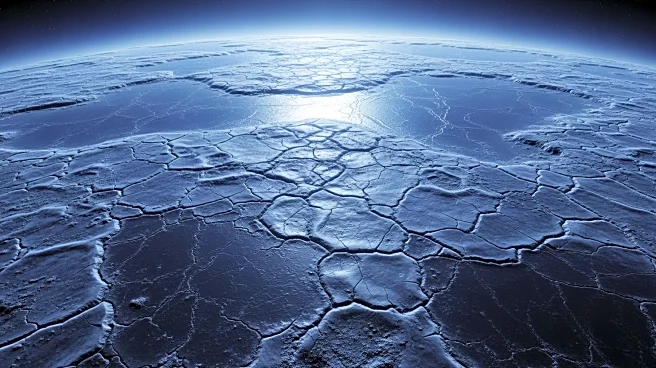
Recent studies have provided new insights into the subsurface oceans of Saturn's moon Titan and Jupiter's moon Europa, challenging previous theories. Data from NASA's Cassini mission suggests that Titan's hypothesized global ocean is more of an icy slush
with pockets of liquid, rather than a continuous body of water. Meanwhile, observations from NASA's Juno mission indicate that Europa's ice shell is thicker than previously thought, potentially limiting interaction between the surface and the ocean beneath. These findings complicate the search for life on these moons.
Why It's Important?
The discovery of subsurface oceans on moons like Titan and Europa has been a key focus in the search for extraterrestrial life. These new findings suggest that the conditions on these moons may be less favorable for life than previously believed. Understanding the true nature of these oceans is crucial for future missions and the development of strategies to explore these environments. The research also highlights the complexity of planetary systems and the need for continued exploration to uncover the mysteries of our solar system.
What's Next?
Future missions, such as NASA's Dragonfly to Titan and the Europa Clipper mission, are expected to provide more detailed data on these moons. Dragonfly, set to launch in 2028, will explore Titan's surface and gather information on its geological and atmospheric conditions. The Europa Clipper, arriving in 2030, will focus on determining the thickness of Europa's ice shell and the potential for life-supporting conditions. These missions will be critical in advancing our understanding of these intriguing worlds and their potential to harbor life.
Beyond the Headlines
The new findings on Titan and Europa underscore the importance of re-evaluating existing data with fresh perspectives. As technology advances, scientists can extract more information from past missions, leading to new discoveries. This iterative process is essential for refining our understanding of the solar system and guiding future exploration efforts. The research also emphasizes the need for interdisciplinary collaboration, as insights from geology, chemistry, and physics converge to unravel the complexities of these distant moons.