


What's Happening?
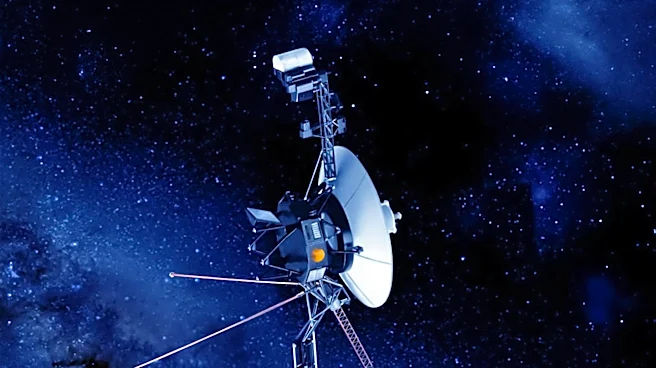
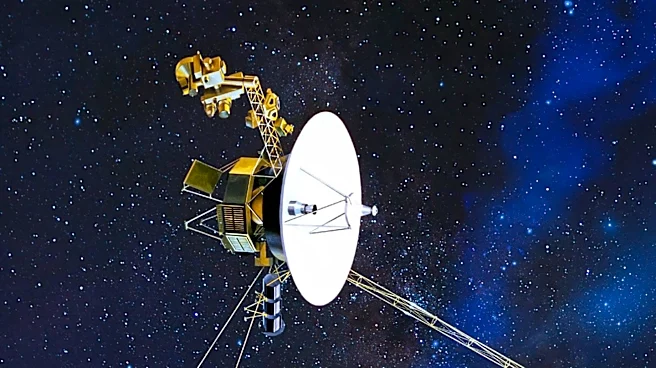
On November 12, 1980, NASA's Voyager 1 spacecraft conducted a close flyby of Titan, Saturn's largest moon, revealing its dense nitrogen-rich atmosphere. This encounter, which occurred at a distance of about 3,900 kilometers above Titan's surface, provided
critical data on the moon's atmospheric composition, including methane and other hydrocarbons. The flyby confirmed that Titan's atmosphere is primarily composed of nitrogen, with a surface pressure about 1.5 times that of Earth's sea level. The mission's trajectory, designed to maximize scientific return from Titan, resulted in Voyager 1 being permanently diverted out of the planetary plane, precluding further encounters with Uranus and Neptune. This decision was part of a strategic mission plan to prioritize Titan's atmospheric study over additional planetary flybys.
Why It's Important?
Voyager 1's findings on Titan have had a profound impact on planetary science, providing insights into the atmospheric chemistry of one of the solar system's most intriguing moons. The data collected during the flyby laid the groundwork for future missions, such as the Cassini-Huygens mission, which further explored Titan's surface and atmosphere. Understanding Titan's atmosphere is crucial for comparative planetology and offers a natural laboratory for studying prebiotic chemistry. The mission's trajectory decision highlights the trade-offs in space exploration, where scientific priorities must be balanced against mission constraints.
Beyond the Headlines
The Voyager 1 mission's choice to prioritize Titan over Uranus and Neptune underscores the complexities of mission planning in space exploration. The decision to focus on Titan's atmosphere has provided invaluable data that continues to inform our understanding of planetary atmospheres and the potential for life elsewhere in the solar system. The mission also demonstrated the effectiveness of gravity assists in altering spacecraft trajectories, a technique that remains vital for deep space exploration. Voyager 1's journey beyond the solar system, following its encounter with Titan, marks humanity's first step into interstellar space, continuing to send back data from the heliosphere.