

What's Happening?
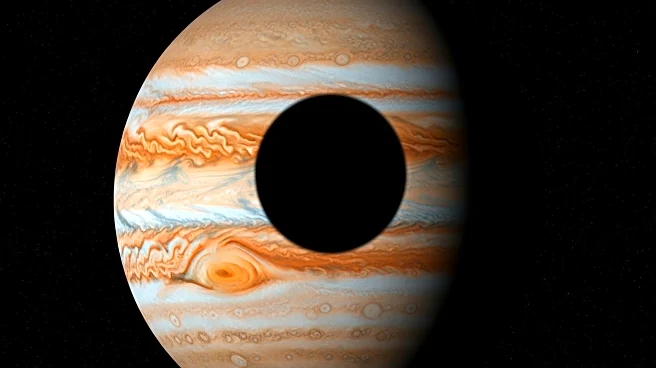
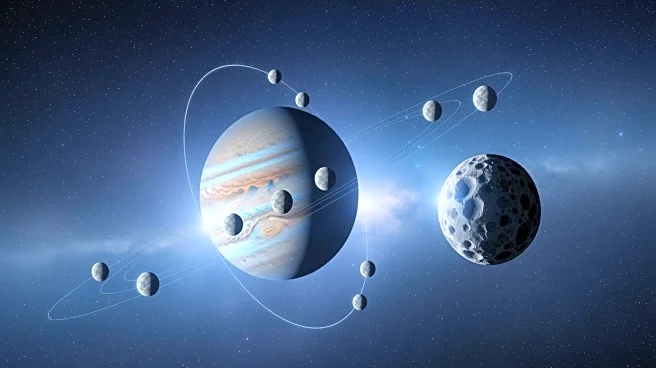
On February 8, 2026, the icy moon Europa will transit across Jupiter, providing a captivating astronomical event. This transit, visible from Earth, will occur as Europa and its shadow cross the face of Jupiter. The event begins shortly before 10 P.M.
EST, with Europa moving in front of Jupiter's disk at 9:54 P.M. EST. The shadow follows approximately an hour and a half later, appearing around 11:20 P.M. EST. By midnight, both Europa and its shadow will be visible, straddling Jupiter's central meridian. The transit concludes around 12:45 A.M. EST on February 9, with the shadow disappearing shortly before 1:15 A.M. EST. This event is part of a series of transits that have been occurring since Jupiter's opposition last month, with the time between the moon and its shadow crossing increasing as the date moves further from opposition.
Why It's Important?
This astronomical event is significant for both amateur and professional astronomers, offering a unique opportunity to observe the dynamics of Jupiter's moons. Such transits provide valuable data on the orbital mechanics of Jupiter's moons and their interactions with the planet's gravitational field. For the public, it serves as an engaging way to connect with space science and the broader universe. The visibility of such events can inspire interest in astronomy and science education, potentially influencing future generations of scientists and space enthusiasts.
What's Next?
Following this transit, astronomers and enthusiasts will continue to monitor Jupiter and its moons for further celestial events. The increasing time between the moon and its shadow crossing will be of interest to those studying the orbital dynamics of Jupiter's moons. Additionally, as the year progresses, other astronomical events will capture the attention of the scientific community and the public, including potential meteor showers, eclipses, and planetary alignments.