


What's Happening?
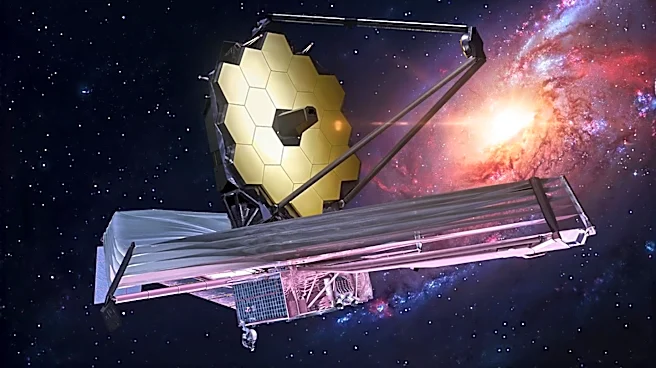
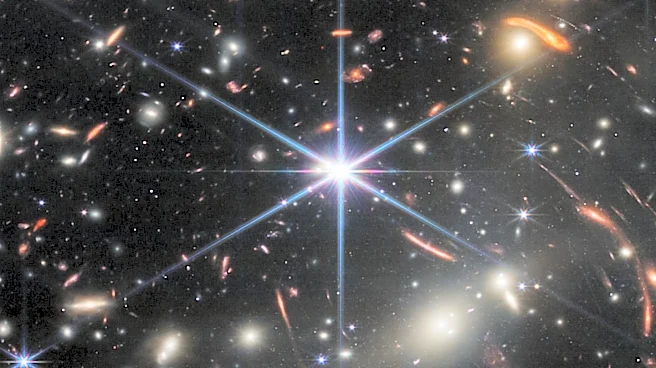
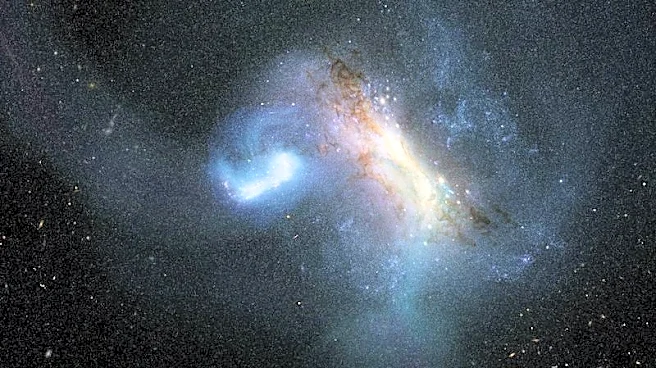
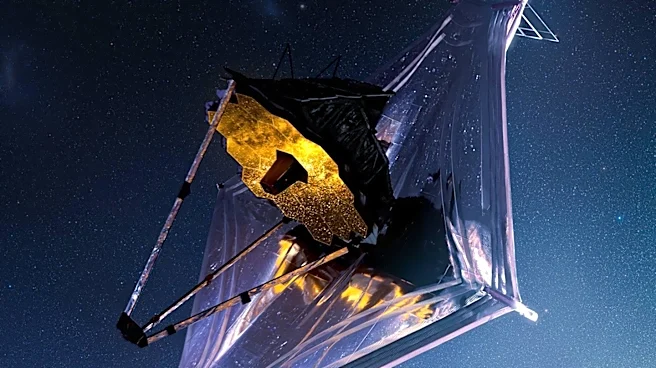
Astronomers have been stunned by the discovery of galaxy GS-z13-1, observed by the James Webb Space Telescope (JWST) as it existed approximately 330 million years after the Big Bang. This galaxy, found as part of the JWST Advanced Deep Extragalactic Survey
(JADES), is remarkably bright in the hydrogen Lyman-alpha emission line in the ultraviolet spectrum. According to current cosmological models, the universe at that early stage should have been largely cloaked in a fog of neutral hydrogen and helium, a period known as the 'Dark Ages,' which would block such UV emissions. Therefore, GS-z13-1 should appear much dimmer, or even be undetectable, based on the prevailing understanding of the reionization process—the period when the universe transitioned from neutral to ionized. This unexpected brightness challenges existing theories about the evolution of the early universe and the timing and mechanisms of reionization.
Why It's Important?
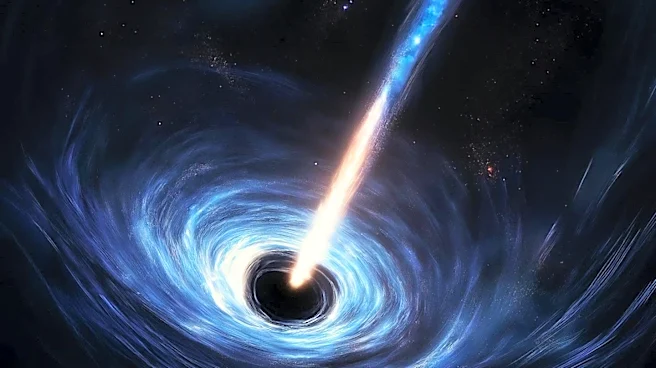
The discovery of GS-z13-1 is highly significant because it directly challenges the standard cosmological model, particularly regarding the reionization epoch. If a galaxy could be so bright and visible at such an early stage, it implies that the universe's reionization process might have occurred earlier or more rapidly than previously thought, or that the first generation of stars (Population III stars) were far more massive, hotter, and luminous. This could necessitate a re-evaluation of fundamental assumptions about star formation, galaxy evolution, and the properties of the early universe. The findings could also point to the presence of early supermassive black holes contributing to the ionization. For the scientific community, this means a potential shift in theoretical frameworks and a renewed focus on understanding the conditions that allowed such a bright galaxy to exist when it 'shouldn't' have, according to current models. It underscores the JWST's capability to reveal unexpected phenomena that push the boundaries of astronomical knowledge.
What's Next?
The unexpected observations of GS-z13-1 will likely trigger extensive research and debate within the astrophysics community. Scientists will focus on refining existing cosmological models and developing new theories to account for such early and bright galaxies. Further observations with the JWST and other advanced telescopes will be crucial to identify more such anomalies and gather additional data on the properties of these early galaxies. Researchers will investigate potential explanations, such as the characteristics of the first stars or the role of active galactic nuclei with early supermassive black holes. This discovery could lead to a deeper understanding of the reionization process and the conditions that led to the formation of the first stars and galaxies. The findings may also influence the design and objectives of future space missions aimed at probing the very early universe.
Beyond the Headlines
The existence of GS-z13-1 touches upon the philosophical implications of scientific discovery, particularly when observations contradict established theories. It highlights the dynamic nature of scientific understanding, where new data can necessitate a complete re-evaluation of long-held models. This situation exemplifies how cutting-edge instruments like the JWST not only confirm predictions but also unveil entirely unforeseen phenomena, pushing the boundaries of human knowledge. The 'shock' and 'astonishment' expressed by astronomers underscore the humility required in scientific inquiry, acknowledging that our understanding of the cosmos is always evolving and incomplete. It also reinforces the idea that the universe holds many secrets yet to be uncovered, encouraging continued exploration and challenging the scientific community to think beyond current paradigms. This discovery could ultimately lead to a more nuanced and accurate picture of cosmic history.