
What's Happening?
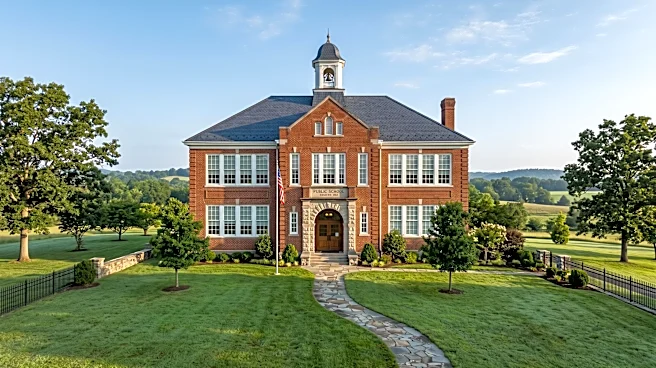
In 1904, Grand Blanc, Michigan, a community then closely tied to Genesee County's agricultural landscape, undertook a significant educational reform by consolidating its rural school districts. This pioneering
move allowed children from surrounding countryside areas to attend a shared school, a step considered unusually early for Michigan education. Students were transported to this central school using horse-drawn vehicles, predating the widespread use of motorized school buses. The original consolidated school building later burned down in 1920, but a replacement opened in 1922, continuing the community's evolving approach to education. Historic photographs from the era also depict Grand Blanc's agricultural roots, including a mill, grain elevator, and a steam-powered tractor, alongside early businesses like Hotel Waldo and the Farmers Exchange Bank, and residential streets with distinctive homes and churches.
Why It's Important?
Grand Blanc's early adoption of school consolidation in 1904 represents a significant milestone in U.S. educational history, particularly within Michigan. This initiative aimed to improve access to education for rural students by centralizing resources and providing a more structured learning environment than scattered one-room schoolhouses. The use of horse-drawn transportation for students highlights the innovative, albeit rudimentary, solutions employed to overcome geographical barriers in education before modern infrastructure was in place. This reform likely contributed to higher educational standards and greater equity for children in the region, setting a precedent for other communities. The integration of educational advancements with the community's agricultural and emerging commercial activities illustrates the holistic development of early 20th-century American towns, where progress in one sector often spurred changes in others. This historical context is crucial for understanding the evolution of public education systems and rural development in the United States.
What's Next?
The historical account of Grand Blanc's school consolidation provides valuable insights into the long-term trajectory of educational policy and community development in the U.S. While the specific challenges of 1904 are different from today's, the underlying principles of improving educational access and resource allocation remain relevant. Modern discussions on school district mergers, funding for rural schools, and transportation logistics can draw parallels from these early efforts. The continuous adaptation of Grand Blanc's educational facilities, from the original consolidated school to its replacement, reflects an ongoing commitment to educational improvement. This historical narrative can serve as a case study for policymakers and educators examining the impact of structural changes on educational outcomes and community resilience.
Beyond the Headlines
Beyond its immediate impact on education, Grand Blanc's story of school consolidation reflects broader societal shifts in early 20th-century America. The move towards centralized schooling was often intertwined with urbanization and the decline of purely agrarian lifestyles, as communities sought to modernize and provide better opportunities for their youth. The photographs of mills, railroad depots, and early automobile-era businesses on Saginaw Street illustrate the transition from a predominantly farming community to one with growing commercial and industrial ties. This transformation also hints at changing social structures and the increasing importance of formal education in preparing individuals for a more complex economy. The community's ability to adapt and rebuild after events like the 1920 school fire further underscores its resilience and commitment to progress, offering a microcosm of American development during a period of significant change.