
What's Happening?
Physicists have proposed a new theory suggesting that the geometry of space itself may be responsible for the forces and particles that make up the universe. This theory, published in Nuclear Physics B,
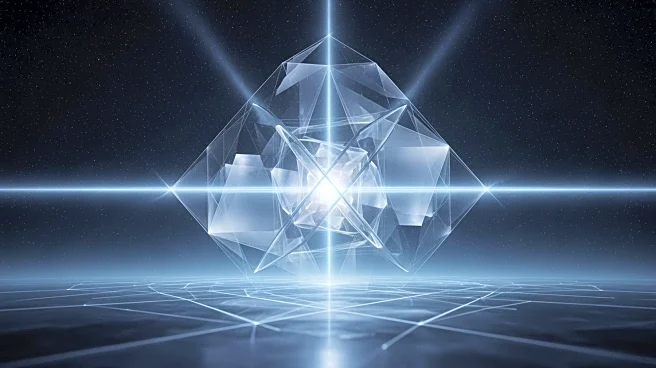
explores the idea that additional dimensions beyond the observable three-dimensional space could be compact and folded into complex seven-dimensional shapes known as G2-manifolds. These shapes, when allowed to evolve over time through a process called G2-Ricci flow, could naturally settle into stable patterns called solitons. This geometric approach offers a potential explanation for phenomena such as spontaneous symmetry breaking and suggests that mass may arise from the torsion within extra-dimensional geometry rather than from an external field like the Higgs field.
Why It's Important?
This new theoretical framework challenges the traditional understanding of mass generation in particle physics, which relies on the Higgs field. By proposing that mass could emerge from the intrinsic properties of spacetime geometry, this theory could lead to a paradigm shift in how fundamental forces and particles are understood. If validated, it could unify the understanding of gravity and other fundamental forces under a single geometric origin, potentially simplifying the complex interactions that govern the universe. This could have profound implications for theoretical physics and cosmology, offering new avenues for research and experimentation.
What's Next?
Future research will likely focus on testing the predictions of this theory through experiments and observations. The potential existence of a new particle, termed the 'Torstone,' linked to geometric torsion, could be a target for detection in upcoming experiments. Additionally, the theory's implications for cosmic expansion and the cosmological constant may be explored further, potentially offering new insights into the accelerating expansion of the universe. Collaboration between theoretical physicists and experimentalists will be crucial in advancing this line of inquiry.