




What's Happening?
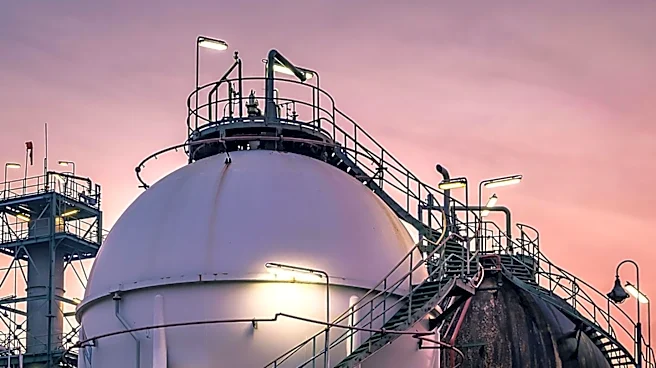
INEOS has announced that the European Union's first full-scale carbon dioxide storage project, known as Greensand, is set to commence operations. This project involves burying emissions beneath the Danish North Sea. In its initial phase, Greensand is designed
to store up to 400,000 tonnes of CO2 annually. The project has plans to scale up significantly, aiming to reach a capacity of 4 million to 8 million tonnes per year. The process involves liquefying CO2 from Danish biomethane plants, transporting it by truck to the Port of Esbjerg, and then shipping it to the depleted Nini West oil field, located approximately 250 km offshore. The CO2 will then be injected about 1,800 meters below the seabed for permanent storage.
Why It's Important?
The Greensand project marks a pivotal moment for the European Union's climate change mitigation efforts, demonstrating a tangible step towards achieving a low-carbon future. As the first full-scale carbon storage initiative, it provides a crucial model for other industries and nations looking to reduce their carbon footprint. This project supports the EU's broader strategy to maintain industrial production, investments, and employment while transitioning to a greener economy. For the U.S., this development showcases a successful large-scale carbon capture and storage (CCS) implementation, which could inform and accelerate similar projects within its own borders. It highlights the potential for CCS technology to play a significant role in decarbonizing hard-to-abate sectors and achieving ambitious climate targets, offering a pathway to manage industrial emissions that cannot be entirely eliminated.
What's Next?
The immediate next step is the full operational launch of the Greensand project, with continuous monitoring of its storage capacity and environmental impact. As the project progresses, INEOS will likely focus on scaling up operations to reach its target capacity of 4 million to 8 million tonnes annually, which will involve further infrastructure development and logistical planning. The success of Greensand could encourage more investment in CCS technologies across the EU and potentially influence policy decisions regarding carbon emissions and industrial decarbonization. Other European countries and international partners will be closely observing the project's performance, potentially leading to the replication of similar initiatives in other depleted oil and gas fields or saline aquifers. The project's long-term viability and cost-effectiveness will be key factors in its broader adoption.
Beyond the Headlines
The Greensand project represents more than just a technological achievement; it embodies a strategic shift in how industrial nations approach climate change. By actively capturing and storing CO2, it addresses the challenge of legacy emissions from existing industries, offering a complementary solution to renewable energy deployment. However, it also raises deeper questions about the long-term safety and permanence of geological CO2 storage, as well as the ethical implications of relying on such technologies versus prioritizing emission reduction at the source. The project's success could influence public perception of CCS, potentially fostering greater acceptance or, conversely, fueling debates about its role in a truly sustainable future. Furthermore, the collaboration between industry and government, as seen in the EU's support, highlights the critical need for policy frameworks and financial incentives to drive large-scale climate solutions.