



What's Happening?
U.S. Central Command (CENTCOM) has officially activated Task Force Scorpion Strike (TFSS), marking the establishment of the military's first dedicated one-way kamikaze drone squadron in the Middle East. This development was highlighted by the successful
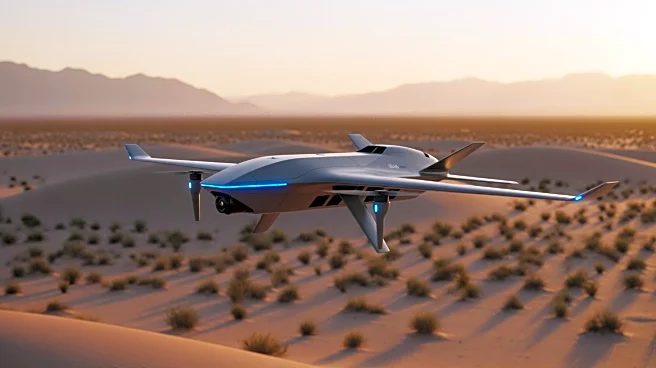
launch of a Low-Cost Uncrewed Combat Attack System (LUCAS) from the USS Santa Barbara in the Arabian Gulf on December 16th. LUCAS, a loitering munition reverse-engineered from Iran's Shahed-136, represents a strategic shift from reliance on expensive platforms like the MQ-9 Reaper. The Pentagon's commitment to this technology is underscored by the rapid development and deployment timeline, with LUCAS integrated into the Rapid Employment Joint Task Force by September and TFSS formed by November. The system is designed to prioritize modularity and sophisticated networking, supporting satellite datalinks for autonomous target hunting and mesh-network swarming.
Why It's Important?
The activation of Task Force Scorpion Strike and the deployment of LUCAS drones signify a pivotal shift in U.S. military strategy, focusing on cost-effective, mass-produced drone technology to counter adversaries employing low-cost production methods. This approach aims to maintain U.S. operational superiority through advanced autonomy and potential AI integration. The Pentagon's broader Drone Dominance program plans to acquire 300,000 low-cost drones, injecting $1 billion into the industry to drive down costs and ensure a resilient supply chain. This strategy could redefine U.S. military capabilities, allowing for more flexible and scalable responses to asymmetric threats in high-attrition environments.
What's Next?
The success of the LUCAS program hinges on the Pentagon's ability to scale production and integrate these systems into existing military operations. This involves training units to manage mass drone deployments and developing new sustainment infrastructure for high volumes of expendable technology. The military's ability to adapt its tactics to accommodate the reality of cheap, ubiquitous, and autonomous flight will determine the effectiveness of this strategy. The Pentagon's goal is to drive the per-unit cost of drones down to as little as $5,000, creating a sustainable model for future drone warfare.