




What's Happening?
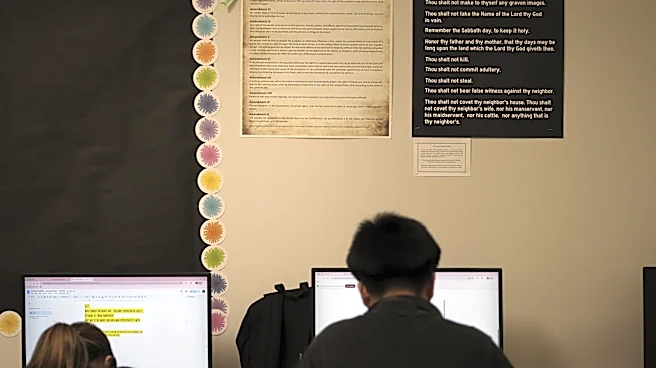
More than two dozen Texas families have formally requested the Supreme Court to review a state law mandating the display of the Ten Commandments in public school classrooms. This petition, filed by the American Civil Liberties Union of Texas and other
advocacy groups, argues that a lower court ruling upholding the law infringes upon the religious freedom rights of public-school children and parents. The filing contends that the 5th Circuit Court of Appeals disregarded a 1980 Supreme Court decision that deemed a similar Kentucky statute unconstitutional. The families, representing diverse religious and nonreligious backgrounds across 22 school districts, assert that the Texas law violates both the Establishment and Free Exercise Clauses of the First Amendment.
Why It's Important?
This case carries significant national importance as it could redefine the separation of church and state in public education. The 5th Circuit's majority opinion, which cited a 2022 Supreme Court decision on a high school football coach's prayer as making the 1980 Kentucky precedent obsolete, is a point of contention. The petitioners argue that only the Supreme Court can overturn its own decisions. If the Texas law is upheld, it could embolden other states, many of which have considered similar legislation, to enact laws that mandate religious displays in public schools. This could lead to an 'administrative nightmare and litigation risk for school districts,' as stated in the filing, and diminish parental control over their children's religious education, particularly for families whose beliefs differ from the displayed text.
What's Next?
The Supreme Court will now decide whether to hear the case. If the Court agrees to review the Texas law, its decision could have far-reaching implications for religious freedom and public education across the United States. A ruling in favor of the Texas law could set a new precedent, potentially allowing for more religious symbols and texts in public school settings nationwide. Conversely, if the Court strikes down the law, it would reinforce existing interpretations of the Establishment Clause and the separation of church and state. The outcome will be closely watched by legal scholars, religious freedom advocates, and educational institutions, as it will shape the legal landscape for religious expression in public schools for years to come.
Beyond the Headlines
Beyond the immediate legal implications, this case touches upon the evolving cultural and social dynamics surrounding religion in public life. The push to display the Ten Commandments in classrooms reflects a broader societal debate about the role of faith in public institutions and the interpretation of foundational constitutional principles. The diverse religious and nonreligious backgrounds of the plaintiff families highlight the complexities of religious pluralism in the U.S. and the challenges of accommodating various beliefs within a public education system. The case also underscores the ongoing tension between religious freedom and the principle of governmental neutrality towards religion, potentially influencing how future generations perceive the relationship between faith, education, and the state.