





What's Happening?
William Cameron Forbes, a Harvard-educated individual with a background in the Forbes family business, served as the Chairman of the Massachusetts Institute of Technology (MIT) Corporation's Visiting Committee on the Department of Economics and Statistics
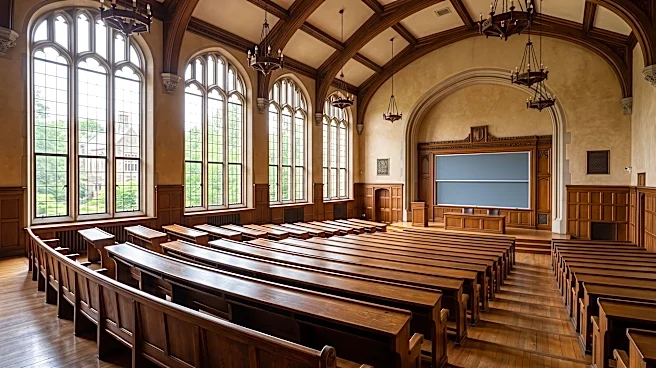
in 1924. The committee's report, submitted on March 12, 1924, addressed various aspects of the department's operations and needs. Key discussions included the possibility of limiting the course in engineering administration, which had seen a reduction in enrollment, and the importance of an advisory council composed of representatives from different industries. The committee also highlighted the need for a larger auditorium or lecture hall for the Elementary Economics and Engineering Administration courses, and recommended an appropriation for an additional assistant professor of accounting. Furthermore, they reiterated a previous recommendation for a fifth-year course and an increase in staff to offer specialized economics courses, as well as the employment of an officer to supervise students' vacation and term-time employment. A significant concern raised was the low salary scale for the department's staff, which made it difficult to attract and retain qualified personnel.
Why It's Important?
This historical report from 1924 offers a glimpse into the early challenges and strategic considerations for academic institutions in the U.S., particularly in the fields of economics and engineering administration. The emphasis on connecting academic programs with industry needs through an advisory council underscores a long-standing recognition of the importance of practical application in education. The struggle to secure adequate funding for faculty salaries and infrastructure, such as lecture halls, reflects perennial issues faced by educational institutions. For U.S. higher education, this highlights the continuous effort to balance academic rigor with financial realities and the evolving demands of the job market. The involvement of prominent figures like William Cameron Forbes, with his extensive experience in business and public service, demonstrates the historical engagement of influential individuals in shaping educational policy and institutional development.
What's Next?
While the immediate 'next steps' for a historical report from 1924 are not applicable in a contemporary sense, the themes it addresses continue to be relevant for modern educational institutions. Universities in the U.S. consistently grapple with issues such as curriculum development to meet industry demands, securing funding for faculty and facilities, and fostering strong ties with external stakeholders. The report's recommendations, such as establishing an advisory council and increasing specialized course offerings, are strategies still employed today to enhance academic programs and student outcomes. The ongoing challenge of competitive faculty salaries remains a critical factor in attracting top talent to academia. Therefore, the historical context provided by this report serves as a foundational understanding of enduring concerns in U.S. higher education administration and policy.
Beyond the Headlines
Beyond the immediate administrative concerns, the 1924 MIT report reflects broader societal and economic shifts in the U.S. during the early 20th century. The focus on engineering administration and economics indicates a growing recognition of the need for skilled professionals who could bridge technical expertise with business acumen, a trend that would continue to shape American industry. The committee's efforts to connect students with industrial enterprises through supervised employment foreshadowed the development of cooperative education programs and internships, which are now integral to many U.S. university curricula. The concern over faculty salaries also touches upon the evolving professionalization of academia and the competition for intellectual capital. This historical document subtly illustrates the foundational period of modern American higher education, where institutions like MIT were actively adapting to serve a rapidly industrializing nation and preparing students for emerging economic landscapes.