




What's Happening?
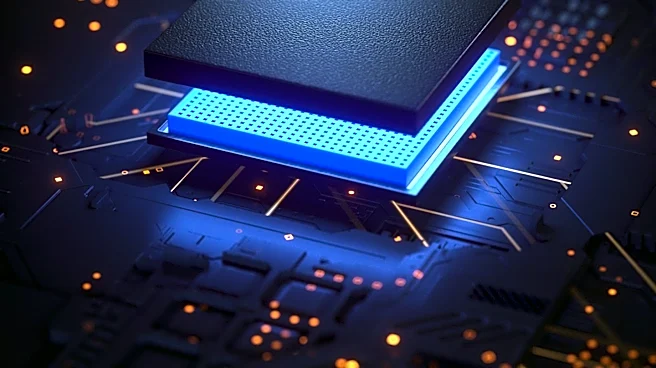
The United States government is reportedly preparing to compel the Netherlands to prohibit ASML, a Dutch company and the world's sole manufacturer of advanced lithography machines, from selling almost any chip-making machines to China. This move, reported by
NU.nl, aims to impede China's advancements in artificial intelligence and supercomputers, which the U.S. government believes also curbs the development of the Chinese military. The U.S. is pushing for the Match Act, a bill currently before the U.S. Congress, which would mandate allies to adopt U.S. export policies for sensitive technologies. If enacted, this bill would ban ASML from selling its older DUV machines to China, which are currently permitted, and prevent the company from maintaining previously delivered machines. Failure by the Netherlands to enforce this ban could result in U.S. sanctions.
Why It's Important?
This action signifies a significant escalation in the U.S. strategy to restrict China's access to advanced semiconductor technology. ASML's lithography machines are indispensable for producing the most complex microchips, making the company a critical choke point in the global semiconductor supply chain. By limiting China's access to these machines, the U.S. aims to slow down China's technological progress, particularly in AI and supercomputing, which have dual-use applications for both civilian and military purposes. The potential ban on DUV machines, in addition to existing restrictions on EUV machines, would further isolate China from cutting-edge chip manufacturing capabilities. This could have profound implications for China's technological self-sufficiency and its long-term economic and military ambitions.
What's Next?
Dutch government officials are actively lobbying in Washington to prevent the Match Act from passing, though their chances appear slim given bipartisan support for the proposal in the U.S. Congress. The bill is expected to be incorporated into the U.S. defense budget, which typically passes. If the Match Act becomes law, ASML would face a comprehensive ban on selling and servicing its DUV machines in China. The Netherlands would then be under immense pressure to comply, as ASML itself relies on American suppliers for its production, making it vulnerable to U.S. threats to disrupt its supply chain. This situation could force ASML to make difficult decisions regarding its business operations in China and its relationship with the U.S. and Dutch governments.
Beyond the Headlines
This geopolitical maneuvering highlights the increasing weaponization of technology in international relations. The U.S. is leveraging its technological leadership and influence over key suppliers like ASML to shape the global balance of power. The Match Act, if passed, would set a precedent for the U.S. to dictate the export policies of its allies regarding sensitive technologies, potentially leading to broader implications for international trade and technological cooperation. This strategy could accelerate China's efforts to develop indigenous semiconductor manufacturing capabilities, even if it means investing heavily in less efficient or older technologies. The long-term consequence could be a further decoupling of global technology supply chains, leading to a more fragmented and potentially less efficient global tech ecosystem.