


What's Happening?
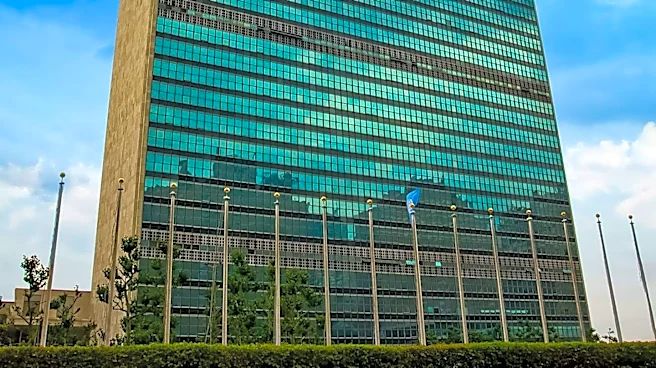
The UN Security Council is experiencing its longest-ever delay in agreeing on leadership for its subsidiary bodies, specifically an eight-month deadlock concerning the Iran sanctions committee. The 10 elected non-permanent members and five incoming countries
issued a joint statement expressing alarm over the situation. This impasse has disrupted the council's work, delayed decisions, and weakened engagement with the broader UN membership. The dispute is linked to disagreements over who should lead the Iran sanctions committee and a broader contention regarding the reimposition of UN sanctions on Tehran through the 'snapback mechanism.' Russia's UN envoy, Vasily Nebenzya, has accused Western council members of refusing to reconsider sanctions regimes that Moscow believes no longer reflect current conditions in Iran. Daniel Forti, head of UN affairs at the International Crisis Group, suggests that Russia, with implicit support from China, is retaliating against the Security Council for last year's decision to reimpose sanctions on Iran.
Why It's Important?
This unprecedented deadlock significantly undermines the effectiveness, credibility, and institutional integrity of the UN Security Council. The inability to appoint leaders for critical sanctions committees, particularly the one overseeing Iran, hampers the council's capacity to implement and monitor international sanctions effectively. Sanctions committees are responsible for overseeing measures such as asset freezes, travel bans, and arms embargoes, and their paralysis can lead to a breakdown in international efforts to prevent the proliferation of weapons and maintain global peace and security. The dispute highlights deep divisions among permanent members, particularly between Russia and Western nations, which could set a dangerous precedent for future international cooperation on critical security issues. The ongoing stalemate could embolden states subject to sanctions, as the enforcement mechanisms are weakened, potentially leading to increased instability in regions like the Middle East.
What's Next?
The elected non-permanent members of the Security Council are attempting to exert public pressure on the permanent members, particularly Russia and China, to show greater flexibility and political will. They hope that public diplomacy can shift the calculations of the permanent members, as quiet diplomacy has not yielded results. The council's working methods typically require agreement on leaders of subsidiary bodies by October 1 for the following year, a deadline that has been severely missed. Until a consensus is reached, successive monthly council presidents will continue to assume caretaker responsibilities to manage urgent business, but this temporary solution cannot address the long-term institutional damage. The resolution of this deadlock will likely require significant diplomatic concessions from the permanent members, particularly regarding the Iran sanctions committee and the broader issue of sanctions reimposition.
Beyond the Headlines
The prolonged deadlock in the UN Security Council reveals a deeper crisis in multilateral diplomacy and the challenges of maintaining international consensus in an increasingly fractured geopolitical landscape. The 'snapback mechanism' dispute, stemming from the 2015 nuclear agreement with Iran, underscores the fragility of international accords when major powers have divergent interests. This situation could lead to a re-evaluation of the Security Council's structure and decision-making processes, potentially sparking debates about the veto power of permanent members or the need for reforms to prevent such prolonged paralysis. The incident also highlights the growing assertiveness of non-permanent members who are increasingly vocal about the need for greater accountability and efficiency within the council. The long-term implications could include a weakening of the UN's authority and a shift towards alternative diplomatic forums for resolving international disputes, potentially leading to a less coordinated global response to future crises.