
What's Happening?
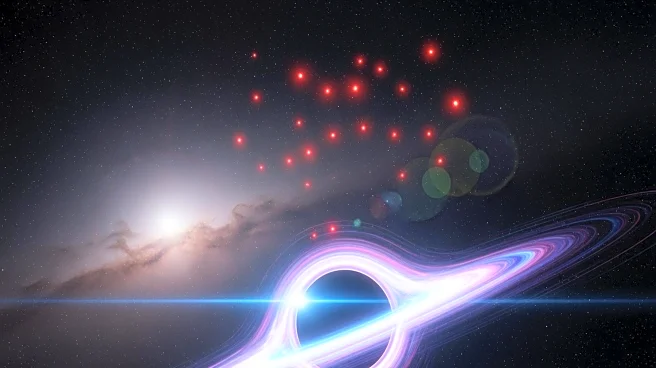
Scientists have potentially solved a cosmic mystery involving 'little red dots' (LRDs) observed by the James Webb Space Telescope. These LRDs, first spotted in December 2022, puzzled astronomers due to
their unexpected characteristics. Initially thought to be dense galaxies or supermassive black holes, the LRDs did not emit the typical X-rays and radio waves associated with such phenomena. Recent research by the Niels Bohr Institute's Cosmic Dawn Center suggests that these LRDs are actually young black holes enveloped in a 'cocoon' of gas. As the black holes consume this gas, they emit heat, creating the distinctive red light observed. This finding, published in the journal Nature, helps explain why the LRDs appeared too massive and mature for early galaxies and lacked the emissions typical of supermassive black holes.
Why It's Important?
This discovery is significant as it challenges existing cosmological theories and provides new insights into the early universe's evolution. The identification of young black holes as the source of the LRDs could reshape our understanding of black hole formation and growth shortly after the Big Bang. It also highlights the capabilities of the James Webb Space Telescope in uncovering previously unseen cosmic phenomena. By resolving the LRD mystery, scientists can refine models of the universe's development, potentially leading to further breakthroughs in astrophysics. This research underscores the importance of advanced telescopes in expanding our knowledge of the cosmos and addressing longstanding astronomical puzzles.
What's Next?
Future research will likely focus on further analyzing the LRDs and similar phenomena to confirm the findings and explore their implications for cosmology. Scientists may use the James Webb Space Telescope and other instruments to observe additional LRDs and gather more data on their properties and behavior. This could lead to a deeper understanding of black hole formation and the conditions of the early universe. Additionally, the study may prompt revisions to existing cosmological models, incorporating the new insights gained from these observations. Continued exploration of the universe's infancy could reveal more about the processes that shaped the cosmos as we know it today.