



What's Happening?
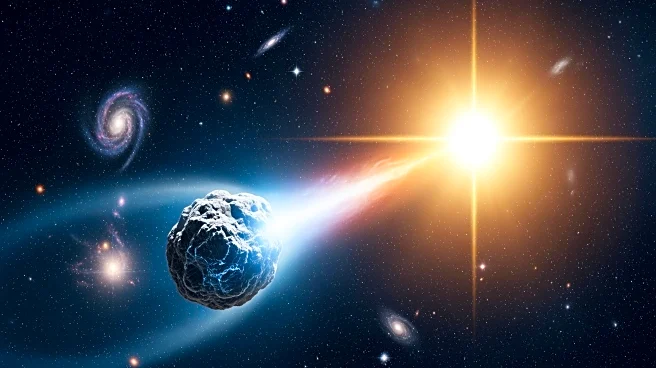
Comet 3I/ATLAS, an interstellar visitor, is departing the solar system, but not without leaving a scientific mark. Researchers have identified wobbling jet structures within a rare sun-facing tail, a feature uncommon among comets. This anti-tail, extending
up to 620,000 miles, displayed jet-like structures that shifted position in a regular, repeating wobble. The periodic wobble suggests a jet source near a pole on a rotating nucleus, indicating a nucleus rotation period of about 15.5 hours. This discovery marks the first periodic jet-angle modulation detected in an interstellar comet.
Why It's Important?
The observation of 3I/ATLAS's unique features provides valuable insights into the behavior of interstellar objects. As the third confirmed interstellar object observed in our solar system, 3I/ATLAS offers a rare opportunity to study material from another star system. Understanding its behavior under the influence of our Sun can reveal new information about the formation and evolution of comets. This knowledge is crucial for advancing our understanding of the cosmos and the processes that govern celestial bodies.
What's Next?
As 3I/ATLAS continues its journey out of the solar system, scientists will analyze the data collected to gain further insights into its composition and behavior. The comet's upcoming proximity to Jupiter in March 2026 may provide additional opportunities for observation and measurement. Researchers will likely publish findings and models based on the data, contributing to the broader scientific understanding of interstellar objects.
Beyond the Headlines
The study of 3I/ATLAS highlights the importance of interstellar objects in expanding our knowledge of the universe. These objects serve as natural laboratories for studying material from other star systems, offering a glimpse into the diversity and complexity of the cosmos. The discovery of unique features in 3I/ATLAS underscores the potential for future interstellar discoveries to challenge and refine existing scientific theories.